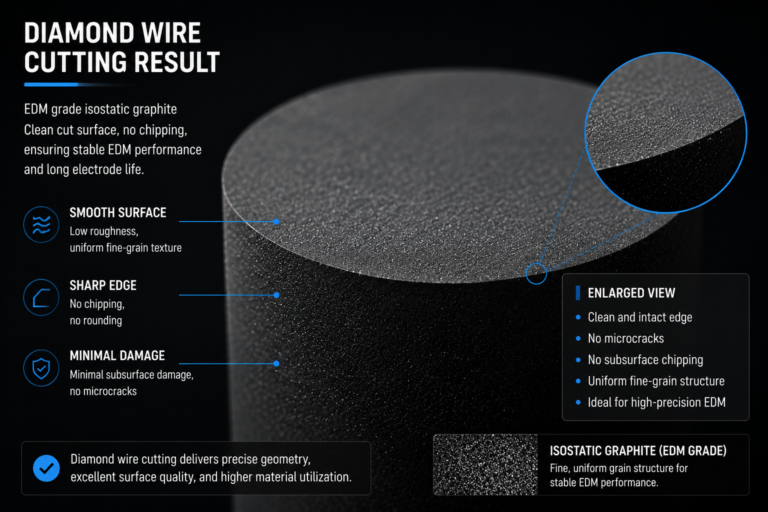
Cleartran ZnS is a denser, tougher grade of zinc sulfide that requires more disciplined cutting control than standard CVD ZnS. Cut it with standard parameters and you get acceptable dimensions but elevated subsurface damage — which shows up later as scatter in the finished window. Cleartran ZnS window manufacturing done correctly delivers cut surfaces with Ra 0.6–1.2 μm and TTV within 8–15 μm on Φ50 mm blanks, ready for polishing with minimal additional stock removal.
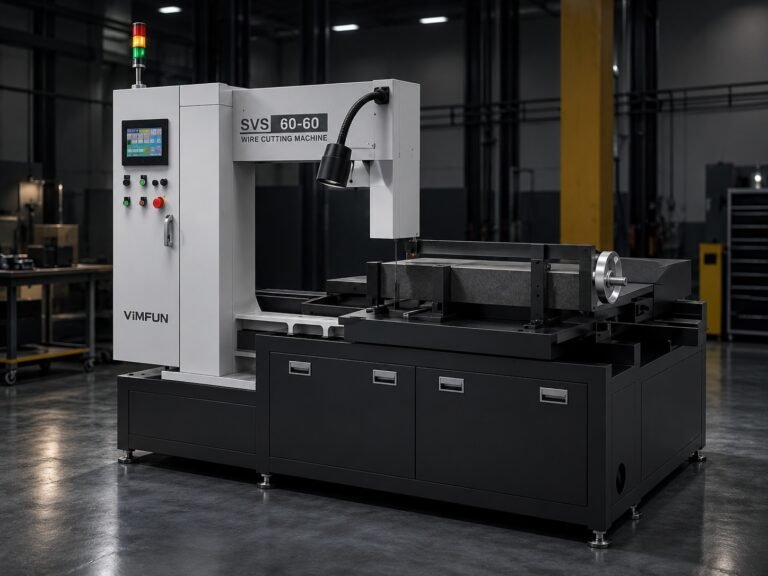
We process Cleartran ZnS windows using endless diamond wire saws. This page covers the machine setup and the cutting results we deliver on Cleartran window blanks.

Why Diamond Wire Saw for Cleartran ZnS
Cleartran is brittle and chips at the blank edge when cutting forces are applied unevenly. Diamond wire saws are the preferred cutting method for Cleartran ZnS window manufacturing because the wire distributes cutting contact across many abrasive points simultaneously, keeping lateral force at any single point low.
The alternative — ID saw blade cutting — applies localized force at the cut entry and exit edges, which produces more edge chipping and deeper subsurface damage on Cleartran. For high-value Cleartran blanks where yield per boule matters, wire saws recover more usable windows per cut sequence.
| Parameter | Diamant-Seilsäge | ID Saw |
|---|---|---|
| Spaltbreite | 0.25–0.45 mm | 0.3–0.6 mm |
| Risiko von Kantenabplatzungen | Niedrig | Mäßig bis hoch |
| Surface Ra after cutting | 0.6–1.2 μm | 0.8–2.0 μm |
| TTV (Φ50 mm) | 8–15 μm | 10–25 μm |
See the ZnS optics cutting machine guide for a detailed wire saw vs ID saw comparison across the ZnS material family.

Our Approach to Cleartran ZnS Window Cutting
We use the same endless diamond wire saw platform that we use for standard ZnS, ZnSe, and germanium optics processing. What changes for Cleartran is the process discipline around wire selection, feed control, and blank mounting — not the equipment itself.
Drahtwahl. We use electroplated diamond wire for Cleartran cutting. Wire diameter is matched to blank size — thinner wire for smaller blanks where kerf efficiency matters most, larger diameter wire for bigger blanks where dimensional stability across the full cut is the priority. The specific wire diameter for a given job is determined during first-article validation.
Entry and exit zone control. The wire entry and exit edges are where Cleartran chipping risk is highest. We use a programmable feed profile that runs slower during the entry and exit portions of each cut, and at full production speed through the main body of the cut. This prevents lateral force spikes at the moments when the wire is engaging or exiting the blank edge.
Blank mounting. Every Cleartran blank is bonded to a glass or carbon backing block before cutting. The backing prevents the wire from cutting into open air at cut completion, which eliminates one of the most consistent sources of exit-zone chipping.
Coolant. White mineral oil, with flow rate targeted at the wire entry point to keep the kerf clear of ZnS swarf throughout the cut. Debris that stays in the kerf scores the cut surface and produces streaks that require additional polishing to clear.
First-article validation. For every new Cleartran job, we cut and measure a first-article blank before committing to production parameters. Parameter windows shift with blank diameter, Cleartran boule origin, and wire wear state — the validated parameter set for one job may not transfer directly to the next.
Cutting Results We Deliver on Cleartran ZnS Windows
The output metrics from our standard Cleartran cutting setup:
| Output Metric | Achieved Value |
|---|---|
| Surface Ra | 0.6–1.2 μm |
| TTV (Φ50 mm blank) | 8–15 μm |
| Spaltbreite | 0.25–0.45 mm (depends on wire diameter) |
| Edge chipping | Controlled with backing support and entry/exit feed reduction |
Values assume the first-article validation step is completed. Blank size, geometry, and Cleartran grade all influence achievable results — for blanks or requirements outside our standard range, please share your drawing and target specs for a job-specific feasibility review.
Cleartran vs Standard ZnS: What Changes at the Cutting Step
| Cutting Factor | Standard CVD ZnS | Cleartran ZnS |
|---|---|---|
| Vorschubgeschwindigkeit | Basislinie | Reduced — Cleartran is harder |
| Wire tension control | Standard | Tighter — drift affects TTV more |
| Coolant flow | Standard | Higher — swarf management critical |
| Ein-/Ausfahr-Vorschubsteuerung | Empfohlen | Zwingend erforderlich |
| Stützmaterial | Empfohlen | Zwingend erforderlich |
| Erststückprüfung | Standard | Erforderlich vor jeder Produktionscharge |
Der praktische Unterschied: Cleartran erfordert mehr Prozessdisziplin bei jedem Schritt, keine andere Ausrüstung. Dieselbe Drahtsägeplattform verarbeitet beides – die Einrichtzeit und die Parameterüberprüfung sind es, die sich ändern.
Anleitungen zum Schneiden von ZnS finden Sie unter Verarbeitung von multispektralem Zinksulfid und die ZnS optics cutting machine Übersicht. Unser gesamtes Sortiment an IR-Optikmaterialien finden Sie auf der Pillar-Seite für die Herstellung von Infrarotoptiken Pillar-Seite.
FAQ
Welche Maschine verwenden Sie zum Schneiden von Cleartran-ZnS-Fenstern?
Endlos-Drahtsägen – dieselbe Plattform, die wir für die Verarbeitung von Standard-ZnS-, ZnSe- und Germaniumoptiken verwenden. Die Maschine ändert sich nicht; die Drahtparameter und das Vorschubprofil ändern sich, um die höhere Härte und Empfindlichkeit gegenüber Beschädigungen von Cleartran anzupassen.
Welche Oberflächenqualität können Sie bei Cleartran-ZnS-Fenstern erzielen?
Ra 0,6–1,2 µm und TTV 8–15 µm auf Φ50-mm-Rohlingen mit Diamantdrahtschneiden. Dies sind die Basiswerte aus unserem Standard-Cleartran-Schneidsystem – tatsächliche Ergebnisse hängen von der Rohlingsgröße, dem Drahtdurchmesser und den Ergebnissen der Erststückprüfung ab.
Was ist die Mindestbestellmenge für das Schneiden von Cleartran-ZnS-Fenstern?
Wir bearbeiten sowohl Einzelstück-Testzuschnitte als auch Produktionsläufe. Kontaktieren Sie uns mit Ihren Rohlingsabmessungen und Ihrer Menge, um Lieferzeit und Einrichtungsanforderungen zu besprechen.
Können Sie Cleartran-ZnS in Sonderformen schneiden?
Ja. Unsere Drahtsägen unterstützen gerade Schnitte für Fensterrohlinge sowie Konturschnitte für nicht rechteckige Fensterformen. Senden Sie uns Ihre Zeichnung zur Machbarkeitsprüfung.
Wie unterscheidet sich das Schneiden von Cleartran-ZnS vom Schneiden von ZnSe?
ZnSe ist weicher als Cleartran-ZnS und wird im Allgemeinen mit höheren Vorschubgeschwindigkeiten bearbeitet. Die Reduzierung des Vorschubs in der Ein-/Ausfahrzone und der Ansatz mit Verbund-Stützmaterial sind für beide Materialien ähnlich. Siehe die Seite zur Politur von Zinkselenidoptiken Seite für Details zum ZnSe-Prozess.