Graphite Machining Alternatives: 7 Proven Methods to Cut Better & Waste Less | Vimfun
Manufacturing Strategy

Graphitbearbeitung
Alternatives

Graphite machining alternatives exist because CNC machining introduces tool wear, dust contamination, and dimensional drift that become unsustainable at production scale. Understand when and why cutting-based processes outperform machining — and how to decide.

60% LessKerf waste vs band saw
±0,05 mmSchnittgenauigkeit
Zero CoolantDry cutting — no contamination
83.2%Material yield with wire saw

What Are Graphite Machining Alternatives?

Graphite machining alternatives are processing methods that replace or supplement conventional CNC milling and turning for graphite — primarily endless diamond wire cutting, precision slicing, and profile wire cutting. They exist because graphite's brittleness, porosity, and anisotropy create specific failure modes in CNC machining that no amount of tooling upgrade fully resolves.

This is not an argument against machining. CNC machining remains the right choice for complex 3D geometries, tight angular tolerances, and low-volume prototype work on graphite. The case for graphite machining alternatives arises in production scenarios where tool wear accumulates, dimensional drift becomes systematic, kerf loss translates to significant material cost, or coolant contamination disqualifies the output for its intended application.

Why CNC Machining Creates Unique Problems in Graphite

Graphite's layered crystalline structure means cutting forces propagate differently than in metals or ceramics. Tool engagement generates localized impact at grain boundaries, producing micro-cracks and edge chipping that are invisible to standard inspection but propagate during downstream handling or thermal cycling. Unlike metal machining, where higher spindle speeds and sharper tooling progressively improve results, graphite machining reaches a point of diminishing returns — the material's fundamental fracture mechanics limit what any rotary tool can achieve.

The alternative approach — continuous diamond wire cutting — operates on a fundamentally different mechanical principle: controlled micro-abrasion at high wire speed (40–70 m/s) with stable, low cutting force. This removes the impact mechanism entirely, reducing subsurface damage depth from 20–50 μm (typical CNC milling) to 2–5 μm (diamond wire). For a detailed comparison, see EDM and alternative machining methods.

The 3 Core Scenarios Where Alternatives Outperform Machining

Not every graphite application needs an alternative to machining. The decision depends on production volume, material value, dimensional requirements, and contamination sensitivity. Three scenarios consistently favor switching: high-volume slicing where kerf loss accumulates into significant material cost; applications requiring zero coolant contact (EDM electrodes, semiconductor components, battery anodes); and large-block processing where CNC tool reach and dimensional consistency over long cuts become limiting factors.
Kernprobleme

4 Gründe, warum CNC-Bearbeitung mit Graphit Schwierigkeiten hat

Dies sind keine Ausnahmefälle oder schlechte Praktiken – es sind strukturelle Einschränkungen der.

01

Schneller und unvorhersehbarer Werkzeugverschleiß

Die abrasiven Partikel von Graphit verschleißen die Schneidkanten von Werkzeugen 5-10x schneller als Stahl. Im Gegensatz zur Metallbearbeitung, bei der der Verschleiß allmählich und vorhersehbar ist, ist der Werkzeugverschleiß bei Graphit stark variabel und hängt von der Sorte, der Kornrichtung und dem Schnittweg ab. Sobald ein Werkzeug stumpf wird, beschleunigt sich die Maßabweichung – und der Übergang von akzeptabel zu außerhalb der Toleranz geschieht schnell über eine Produktionscharge hinweg.

Maßrisiko
02

Kantenabsplitterung und Mikrorisse

Rotary tool engagement applies intermittent mechanical impact at graphite grain boundaries. Each tooth-material contact event is a micro-fracture risk. The resulting edge chipping and subsurface micro-cracks are often below the detection threshold of standard visual inspection but propagate under thermal or mechanical load in service — causing failures that trace back to the machining stage.

Quality Risk
03

Coolant Contamination of Porous Structure

Graphite's open pore network permanently absorbs water-based coolants and cutting oils. This alters the material's electrical conductivity, thermal properties, and surface energy — disqualifying it for EDM electrode, semiconductor furnace, and battery anode applications. Dry machining is technically possible but generates excessive dust and accelerates tool wear further, worsening both problems simultaneously.

Application Risk
04

High Material Loss on Every Cut

CNC end milling and slot cutting produce kerf widths of 2–8 mm. For high-value isostatic graphite at $10–20/kg, this material loss is substantial. Across a production run of large blocks, the cumulative cost of machining waste often exceeds the cost of equipment amortization — yet it is rarely tracked as a controllable variable in machining cost models.

Cost Risk
Method Comparison

Graphite Processing Methods: Head-to-Head

Each method has a legitimate role in graphite production. The table below maps the technical trade-offs to help identify where alternatives to machining deliver the most measurable improvement.

MethodeKerf / WasteSubsurface DamageKühlmittelGenauigkeitBest Application
Endlos-Diamant-Seilsäge≤ 0.8 mm2–5 μm (low)None — dry±0,05 mmSlicing, profiling, inner hole — all materials
Bandsäge2.0–4.0 mm10–20 μmOptional±0.2–0.5 mmRough block separation, low-precision slicing
CNC Milling / End Mill3.0–8.0 mm20–50 μm (high)Required±0,01–0,05 mmComplex 3D geometries, prototypes
ID Saw (Disc)0.4–0.8 mm5–15 μmRequired±0,05 mmThin wafer slicing, small-format blanks
Reciprocating Wire Saw0.4–0.8 mm8–15 μmOptional±0,1 mmGeneral slicing where reversal marks acceptable
Wasserstrahlschneiden1.0–2.0 mmHigh (pore saturation)Yes — water±0.1–0.2 mmNot recommended for precision graphite applications
Key insight:  For purity-sensitive graphite (EDM electrodes, battery anodes, semiconductor components), the coolant column alone eliminates most methods. Diamond wire cutting is the only method combining narrow kerf, low damage, and dry operation.
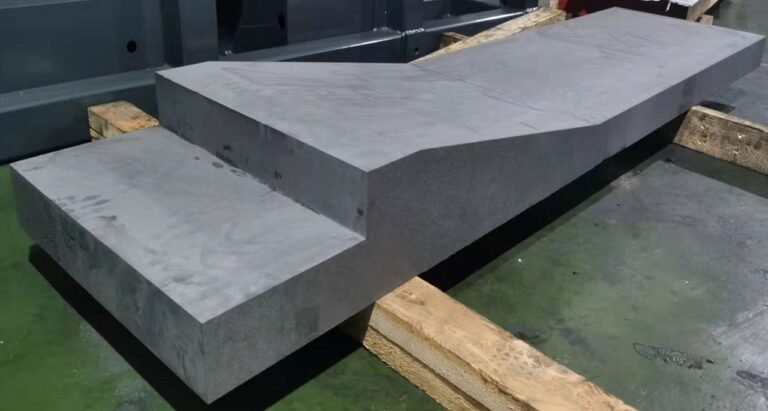
graphite machining alternatives in action — diamond wire saw cutting large isostatic graphite block dry
+42 extra slices/m³
The Engineering Case

Why Diamond Wire Is the Most Effective Alternative to Graphite Machining

The switch from CNC machining to diamond wire cutting is not about machine cost — it is about the fundamental difference between impact-based material removal and controlled micro-abrasion. The physics favor wire cutting for graphite at every level.

01

No tool wear accumulation — consistent output across the batch

Diamond wire degrades gradually and predictably, with no sudden dimensional step-change. Wire life is ~7 days at 8h/day, monitored by cut time. CNC tool wear is abrupt and variable, making batch consistency structurally harder to maintain.

02

Kerf loss reduced by 60–80% — directly recovered as usable material

A 1 m³ isostatic graphite block sliced to 4 mm sections yields 42 additional slices with wire saw vs. band saw — worth $4,662 per block at EDM-grade price ($15/kg). At 10 blocks/month, that is $559K in annual recovered material value.

03

Dry cutting eliminates contamination risk entirely

No coolant enters the graphite pore structure. Output meets purity specifications for EDM electrodes, semiconductor furnace components, and battery anodes without additional decontamination steps that add cost and cycle time.

04

Subsurface damage 10× lower — fewer downstream failures

Diamond wire's 2–5 μm damage depth vs. CNC milling's 20–50 μm means less grinding stock required to clean the surface, thinner achievable final dimensions, and fewer thermal/mechanical failures that trace back to cutting stage damage.

Decision Framework

When to Keep Machining, When to Switch

The right answer depends on your specific application, material, and production context. This framework maps the decision across four dimensions: geometry, volume, material value, and contamination sensitivity.

Keep CNC Machining When

Machining Remains the Right Tool

  • Complex 3D geometries requiring simultaneous multi-axis contouring (not achievable with 2-axis wire cutting)
  • Low-volume prototype and R&D work where setup time dominates and material cost is secondary
  • Tight angular tolerances on multiple faces in a single setup — CNC retains its advantage here
  • Small-batch custom shapes where the flexibility of CNC programming outweighs its material waste
  • Non-purity-critical applications where coolant contamination is acceptable
Switch to Wire Cutting When

Drahterodieren übertrifft die Bearbeitung

  • Produktionsvolumen-Schneiden, bei dem der Schnittverlust pro Block bei größeren Mengen zu messbaren Materialkosten führt
  • Ausgabe für EDM-, Halbleiter- oder Batterieanwendungen, die keinen Kühlmittelkontakt erfordern
  • Große Blockformate (500 mm+), bei denen die CNC-Maßhaltigkeit über lange Schnittwege abnimmt
  • Dünnschnittschneiden unter 5 mm, bei dem CNC-Vibrationen und Werkzeugablenkung inakzeptable Fehler verursachen
  • Oberflächenqualitätsanforderungen, bei denen die CNC-Schädigungstiefe unter der Oberfläche durch Schleifen nicht vollständig korrigiert werden kann

4 Produktionssignale, die darauf hindeuten, dass es Zeit ist, Alternativen zu prüfen

Steigende Ausschussrate über Chargen hinweg

Werkzeugverschleißschwankungen, die chargenübergreifende Maßabweichungen über dem Toleranzband verursachen.

Kostendruck bei hochwertigem Graphit

Isostatischer Graphit zu $10–20/kg macht jede mm Schnittreduzierung finanziell bedeutsam.

Oberflächenfehler, die auf das Schneiden zurückgeführt werden

Nachgelagerte Qualitätsbeanstandungen, die auf unter der Oberfläche liegende Mikrorisse oder Kantenschäden im Schneidstadium zurückzuführen sind.

Neue Anwendung, die Reinheitskonformität erfordert

EDM-, Halbleiter- oder Batterie-Kundenspezifikationen verbieten ausdrücklich den Kühlmittelkontakt mit Graphit.

Vertiefende Themen

Deep Dive: Every Dimension of the Machining vs Cutting Decision

Each topic below isolates a specific engineering or economic aspect of the graphite machining alternatives decision — from process mechanics to cost logic to the replacement decision itself.

SP — 1.1

Graphite Cutting vs Machining

The fundamental difference between material separation (cutting) and material removal (machining) — how force mechanics, damage depth, and process stability differ, and why "more precise machining" does not solve graphite's core problems.

Graphitschneiden vs. Zerspanenmachining vs cutting
Read in depth →
SP — 1.2

Limitations of CNC Machining for Graphite

A detailed breakdown of CNC machining's failure modes in graphite production — tool wear mechanics, dimensional drift, micro-cracking formation, and why these problems are structural, not solvable by better equipment.

Einschränkungen bei der GraphitbearbeitungCNC machining graphite problems
Read in depth →
SP — 1.3

Graphite Cutting as a Machining Alternative

When and how cutting-based processes replace machining — the engineering conditions that make cutting the superior choice, and how to frame the transition as a process engineering decision rather than a technology swap.

Graphitschneidalternativealternative to graphite machining
Read in depth →
SP — 1.4

Materialverlust bei der Graphitbearbeitung

The full cost accounting of material loss in graphite machining — where waste originates, how it is systematically underestimated, and why kerf control delivers greater ROI than tooling optimization in high-value graphite production.

graphite machining material lossgraphite machining waste
Read in depth →
SP — 1.5

Surface Damage Caused by Graphite Machining

What machining-induced surface and subsurface damage looks like, why standard inspection misses it, how it affects EDM performance and mechanical reliability, and why polishing cannot fully recover from machining-stage damage.

Beschädigung der Graphitbearbeitungsoberflächesurface defects machining
Read in depth →
SP — 1.6

Process Stability in Graphite Manufacturing

What production stability means beyond single-part accuracy — how tool wear drift, batch variation, and process consistency determine whether a manufacturing route is viable at scale, and where cutting has a fundamental advantage.

Graphitherstellungsstabilitätprocess stability
Read in depth →
SP — 1.7

When to Replace Machining with Cutting in Graphite

A practical decision framework — the four production signals that indicate alternatives should be evaluated, the common objections and how to address them, and how to approach a gradual transition rather than a full process replacement.

replace graphite machiningmachining alternative decision
Read in depth →
Our Machines

Graphite Cutting Machines by Vimfun

Three machine configurations covering the full range of graphite cutting requirements — from precision EDM electrode blanks to large-format block slicing. All built on endless diamond wire technology: dry cutting, low kerf, ±0.05 mm accuracy.

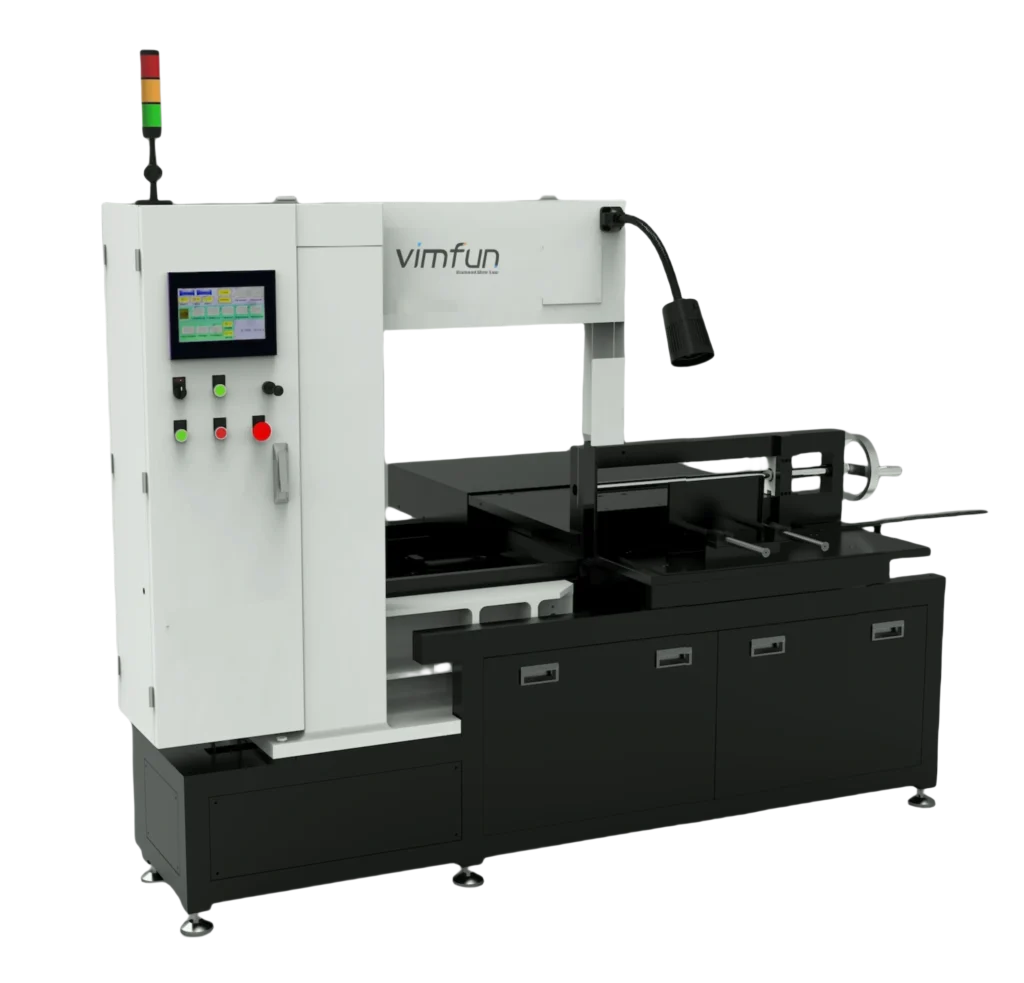
SVI 80-80 vertical graphite cutting machine — alternative to CNC machining for batch production

SVI 80-80 — Batch Slicing + Profile Cutting

  • Max workpiece: 800 × 800 × 800 mm
  • Slice, outer contour, inner-hole in one machine
  • Accuracy: ±0.05 mm | Kerf: ≤ 0.8 mm
  • Most versatile model for production replacement
View Machine →
SVI 250-80 large-format graphite cutting machine used by Mersen Graphite

SVI 250-80 — Large Block Processing

  • Max workpiece: 2,500 × 800 mm
  • Deployed by Mersen Graphite globally
  • Handles oversized blocks without pre-cutting
  • Dry cutting — semiconductor-grade purity
View Machine →

Ready to Evaluate Alternatives to Graphite Machining?

Send a graphite sample — we run a free test cut and return a full surface quality and kerf measurement report before any purchase commitment. Our engineering team can assess your current machining process and recommend the right cutting solution.

Free test cut for all graphite grades
24h response on technical enquiries
1 Jahr machine warranty included
Mersen Graphite verified deployment
Nach oben blättern