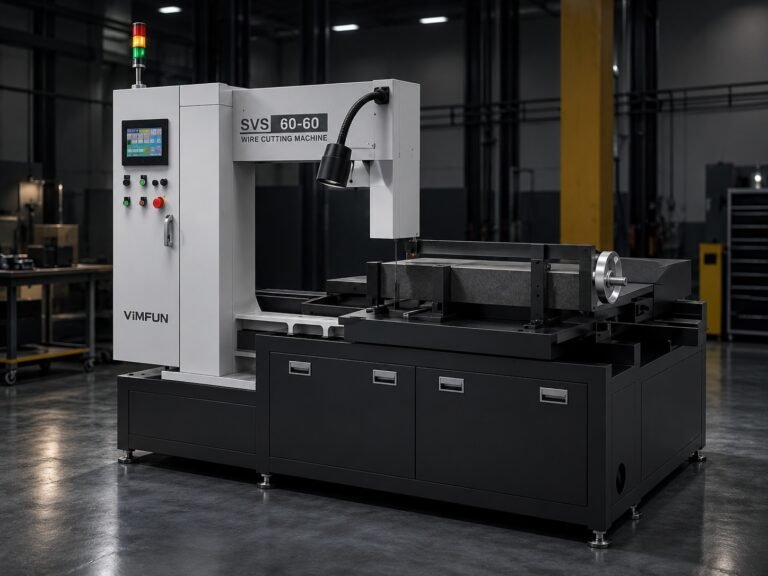
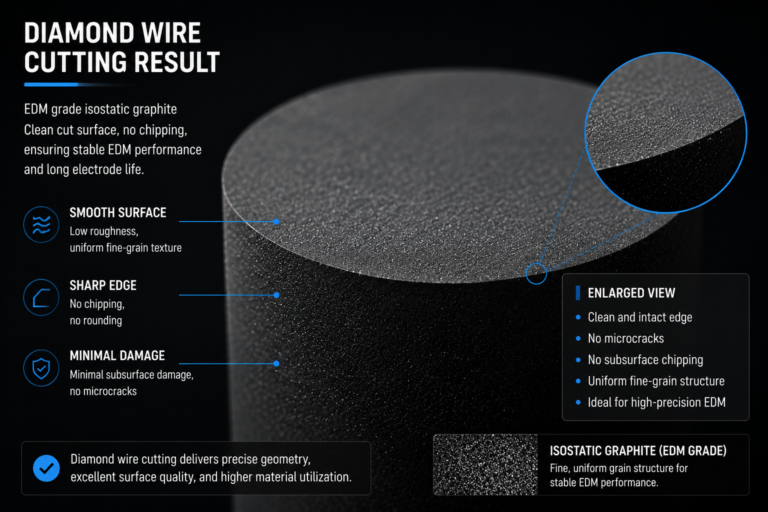
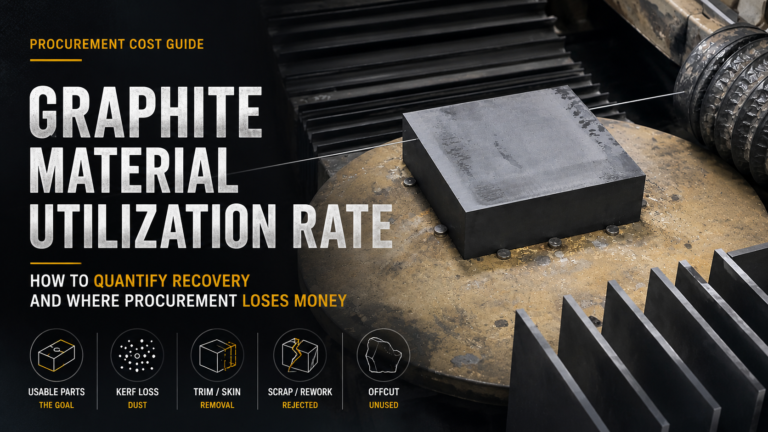
Вы читали об ограничениях обработки графита на станках с ЧПУ. Вы видели цифры на материальные потери и повреждение поверхности. Вопрос не в том, есть ли проблемы у традиционной обработки графита — вопрос в том, оправдывает ли ваша конкретная производственная ситуация переход на алмазную резку проволокой.
Это руководство предоставляет структурированную основу для принятия решений. Не каждая операция с графитом должна заменять механическую обработку резкой. Но для многих — особенно тех, кто работает с дорогостоящим графитом, жесткими допусками или проблемами с управлением пылью — переход окупается быстрее, чем большинство решений о капитальном оборудовании.
Почему производители ищут замену обработке графита
Стремление заменить обработку графита вызвано не одной проблемой. Это накопление нескольких:
Отходы материала недопустимы при текущих ценах на графит. Графит, полученный изостатическим прессованием для полупроводниковых применений и применений в электроэрозионной обработке, стоит от 50 до 200+ долларов за килограмм. Обработка на станках с ЧПУ обычно приводит к потере 30–50% исходного блока в виде стружки и пыли. Когда ваш счет за сырье составляет более 500 000 долларов в год, процесс, который теряет треть этого, заслуживает внимания.
Пыль создает операционные и медицинские расходы. Графитовая пыль от механической обработки является проводящей, абразивной и классифицируется OSHA как загрязняющая частица. Она повреждает подшипники, загрязняет электронику и требует дорогостоящих систем экстракции. Эти расходы редко отражаются в стоимости обработки за деталь, но они реальны.
Целостность поверхности имеет большее значение, чем раньше. Поскольку приложения требуют более жестких допусков — плоскостность держателей полупроводниковых пластин составляет 5 мкм, электроды для электроэрозионной обработки — ±0,02 мм — повреждение подповерхностного слоя от агрессивной обработки на станках с ЧПУ становится проблемой качества, а не просто косметической проблемой. Поврежденные поверхности означают больше этапов финишной обработки, больше брака и больше жалоб клиентов.
Сроки выполнения заказов находятся под давлением. CNC machining graphite requires fixturing, tool changes, and multiple passes. For custom geometries or small batches, setup time can exceed cutting time. Manufacturers need faster turnaround without sacrificing quality.
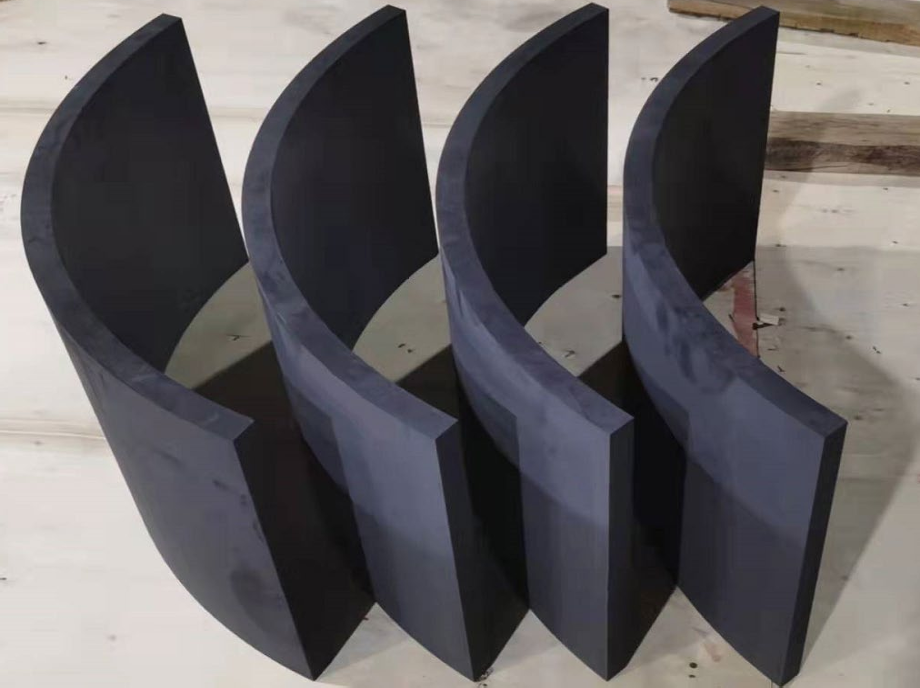
The Replace Graphite Machining Decision Matrix
Not every graphite machining operation should switch. Here’s how to evaluate your situation:
When Replacing Graphite Machining Makes Strong Sense
| Your Situation | Why Diamond Wire Cutting Wins |
|---|---|
| Graphite cost > $80/kg | Material savings from narrow kerf (0.3–0.5 mm vs 3–5 mm tool path) pay back quickly |
| Part thickness < 10 mm | Thin slicing is wire cutting’s core strength; CNC struggles with deflection on thin parts |
| Tolerance requirement ±0.05 mm or tighter | Wire cutting delivers consistent thickness without tool wear drift |
| Batch sizes 10–500 pieces | Minimal setup time; no fixturing changes between cuts |
| Complex contour profiles | Wire follows CNC-programmed paths; no tool radius compensation needed |
| Dust management is costly | Wire cutting with coolant produces slurry, not airborne dust |
| Surface finish Ra < 1.0 μm required | As-cut surface from diamond wire often meets spec without secondary finishing |
When Keeping CNC Machining Makes Sense
| Your Situation | Why CNC Machining Is Still Better |
|---|---|
| 3D pocket milling or complex cavities | Wire cutting is a 2.5D process; it can’t machine blind pockets |
| Very large stock removal (>50% of block) | CNC roughing is faster for bulk material removal |
| One-off prototypes with 3D geometry | CNC’s flexibility for arbitrary 3D shapes is unmatched |
| Existing CNC cell is fully depreciated | If equipment cost is sunk and utilization is low, the incremental cost to machine is minimal |
| No slicing or profiling operations | If your graphite work is entirely 3D milling, wire cutting doesn’t apply |
Гибридный подход: используйте оба метода
Многие производители, заменяющие графитовую обработку, не отказываются полностью от ЧПУ. Наиболее эффективная установка использует алмазную резку проволокой для:
- Нарезка — преобразования блоков в пластины или диски
- Профилирование контура — вырезание 2D-форм из заготовок
- Обрезка — придание заготовкам формы, близкой к конечной, перед окончательной обработкой
Затем обработка на станках с ЧПУ выполняет:
- Фрезерование 3D-элементов — карманы, каналы, сложные поверхности
- Финишная обработка — где требуются определенные текстуры поверхности
- Сверление отверстий — сквозные отверстия и зенковки
Этот гибридный рабочий процесс сокращает время работы станков с ЧПУ на 40–60% (меньше черновой обработки), продлевает срок службы инструмента (меньше абразивного материала для удаления) и пропорционально снижает образование пыли.
Как заменить графитовую обработку: пошаговое руководство
Step 1: Audit Your Current Graphite Operations
Before investing in new equipment, understand where your current process wastes money:
Material utilization audit:
- What percentage of purchased graphite becomes finished parts? (Industry average for CNC: 50–70%)
- What does the wasted material cost per month/year?
- Which part numbers have the worst buy-to-fly ratio?
Quality audit:
- What’s your scrap rate at final inspection?
- How many parts need rework for dimensional issues?
- Are surface finish rejects traced back to machining damage?
Cost audit:
- CNC tool cost per month (end mills, drills — graphite destroys tooling)
- Dust extraction system maintenance cost
- Machine downtime for graphite-related cleaning
If your material waste exceeds 35%, your tool cost exceeds $2,000/month, or your scrap rate exceeds 5%, there’s likely a strong case to replace graphite machining for at least part of your workflow.

Step 2: Identify Which Operations to Replace First
Start with the highest-impact operations:
Priority 1: High-volume slicing. If you’re cutting graphite blocks into plates or discs, this is the most straightforward replacement. Diamond wire cutting does this faster, with less waste, and better surface quality than bandsaw or CNC slotting.
Priority 2: Contour cutting of expensive graphite. Any operation where you’re profiling shapes from high-value isostatic graphite. The kerf savings alone often justify the equipment.
Priority 3: Thin-section work. Any part thinner than 5 mm that currently requires careful CNC programming to avoid breakage. Wire cutting handles thin graphite sections without deflection risk.
Step 3: Run Comparative Trials
Don’t make the decision on paper alone. Get actual data:
- Send sample blanks to an equipment supplier for test cuts
- Measure surface roughness, dimensional accuracy, and edge quality on the test pieces
- Calculate cycle time per part and compare to your current CNC time
- Inspect for subsurface damage (cross-section under microscope if needed)
The test results should show you exactly how much material you save per cut, what surface quality you achieve, and whether the dimensional accuracy meets your spec.
Step 4: Calculate ROI
The ROI calculation for replacing graphite machining involves several factors:
Direct savings:
- Material saved per part (kerf reduction)
- Reduced CNC tool consumption
- Lower scrap rate
- Reduced dust extraction costs
Indirect savings:
- Faster setup and changeover
- Less machine cleaning downtime
- Reduced finishing operations (if as-cut surface is acceptable)
- Lower health and safety compliance costs
Investment:
- Diamond wire cutting machine ($15,000–$45,000 depending on capacity)
- Diamond wire consumables (~$0.50–$2.00 per cut depending on material)
- Operator training (typically 1–2 days)
- Coolant system and maintenance
For a typical graphite machining operation processing $200,000+ in raw material per year, the payback period is usually 6–12 months when replacing even 30–40% of CNC operations with wire cutting.
Step 5: Implement in Phases
Don’t rip out your CNC machines on day one. Phase the transition:
Phase 1 (Month 1–2): Install wire cutting machine alongside existing CNC cell. Route all slicing operations to wire cutter. Keep CNC for everything else.
Phase 2 (Month 3–4): Add contour cutting operations. Optimize wire cutting parameters for your specific graphite grades. Track material savings and quality metrics.
Phase 3 (Month 5+): Evaluate which remaining CNC operations could move to wire cutting. Consider adding a second wire cutter if utilization exceeds 70%. Redeploy freed CNC capacity to higher-value work.
Common Concerns When Replacing Graphite Machining
“Our operators don’t know wire cutting.”
Diamond wire cutting machines are simpler to operate than 3-axis CNC. There’s no G-code programming for basic slicing operations. Most operators are productive within 2–3 days. For CNC contour cutting, the learning curve is similar to operating any CNC machine — the control interface is familiar.
“We can’t afford downtime during the transition.”
That’s why phased implementation works. The wire cutter runs in parallel with your existing CNC cell. You’re adding capacity, not replacing it. Operations only move to the wire cutter after you’ve validated the process on your actual parts.
“What about parts that need both cutting and machining?”
This is the most common scenario. The wire cutter produces near-net-shape blanks that go to CNC for final features. Your CNC programs get simpler (less roughing), your cycle times drop, and your tool life improves. It’s not either/or — it’s a workflow optimization.
“Diamond wire seems expensive as a consumable.”
A single diamond wire loop costs $30–$80 and lasts for 20–100+ cuts depending on the graphite grade and cut length. Compare that to the CNC end mills you’re burning through — at $15–$50 each, lasting 30–60 minutes in abrasive graphite before needing replacement. Wire consumable cost per part is typically lower than CNC tooling cost per part, not higher.
The Bottom Line: When to Replace Graphite Machining
If you process graphite at scale and your current CNC workflow wastes more than 30% of raw material, you should seriously evaluate replacing at least the slicing and profiling operations with diamond wire cutting. The material savings, quality improvement, and dust reduction make a compelling case for most operations.
The manufacturers who get the best results don’t treat it as a full replacement — they treat it as a process stability upgrade. Wire cutting handles what it does best (slicing, profiling, near-net shaping), and CNC handles what it does best (3D features, complex cavities, final finishing). The result is a leaner, cleaner, more efficient graphite manufacturing process.
Ready to evaluate whether diamond wire cutting works for your graphite operations? Start with a side-by-side comparison of cutting vs machining for your specific applications, or explore the full range of graphite machining alternatives available today.