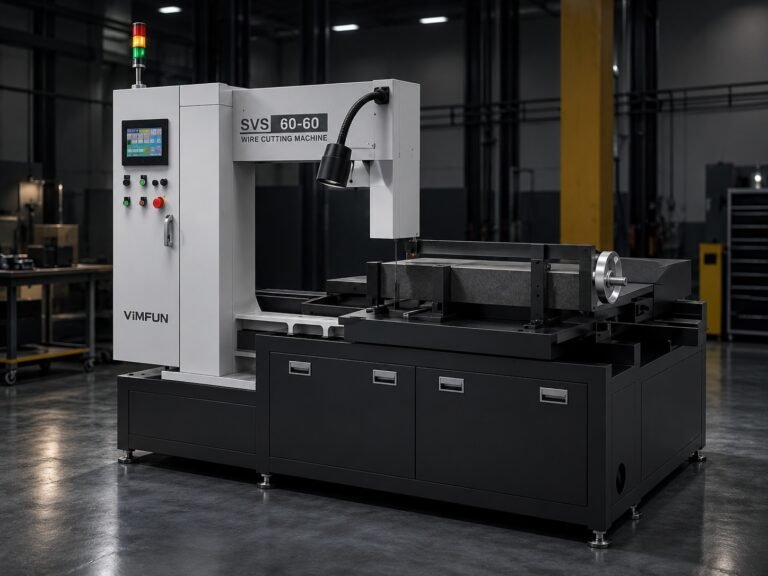
Wir hatten eine Charge von 200 EDM-Elektroden kommen aus der CNC-Bearbeitung zurück. Die ersten 50 sahen perfekt aus. Bei Stück 120 fehlten sie bereits die Maßangaben – 10,05 mm statt 10,00 mm. Bei 180 waren die Hälfte Ausschuss.
Tool wear. The CNC spindle had drifted, and by the time we caught it, 40% of the batch was useless.
That’s when we started looking at graphite electrode cutting vs machining ernsthaft – speziell das Diamantdrahtschneiden als Alternative. Nicht, weil das Drahtschneiden eine magische neue Technologie ist, sondern weil es ein grundlegendes physikalisches Problem löst, dem die CNC-Bearbeitung nicht entkommen kann.
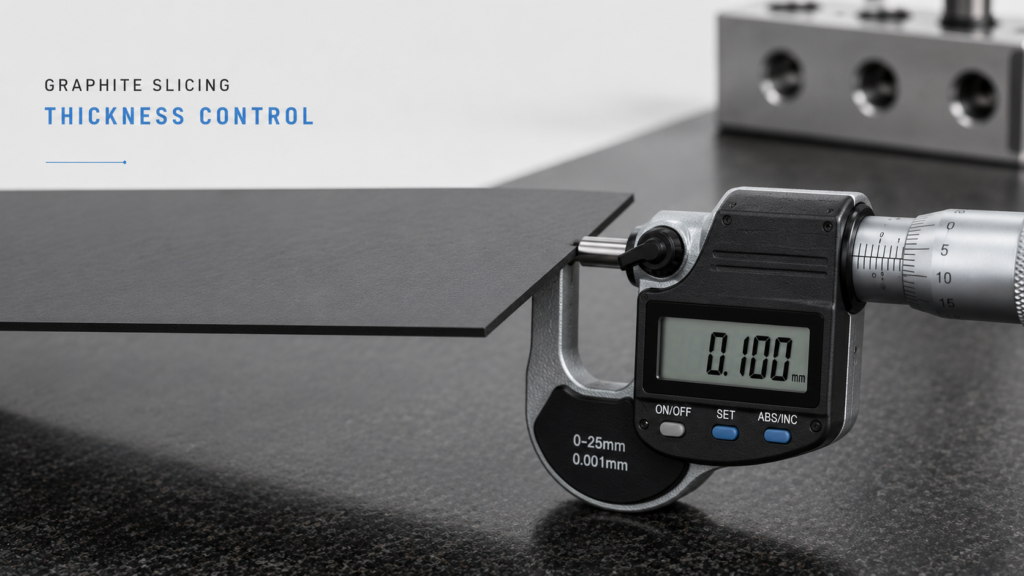
The Fundamental Difference: Separation vs Removal
This is where most people get it wrong. They think cutting and machining are just two ways to do the same job, with one faster or cheaper. They’re not. They solve different problems at the material level.
Machining = Material Removal
A CNC tool presses into the graphite surface with concentrated force. The tool chips away small bits. What happens in the subsurface? The stress concentrates at the tool-material interface, crack initiates below the surface, and that crack propagates into the bulk. The removed chip is damaged — but so is what remains.
This matters for graphite because graphite is brittle. Once a crack starts, it doesn’t stop at the surface. This is one of the core Einschränkungen der CNC-Bearbeitung für Graphit — the material itself fights back against the tool.
Diamantdrahtschneiden = Materialtrennung
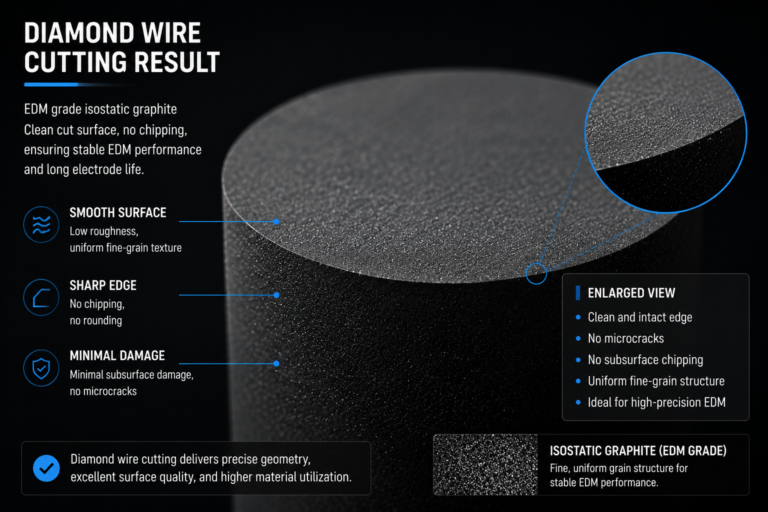
Eine Diamantdrahtsäge bewegt sich kontinuierlich durch den Graphit und trennt Material entlang einer kontrollierten Ebene. Im Gegensatz zu einem rotierenden CNC-Werkzeug verteilt der Draht die Schneidkraft über die gesamte Schnittbreite (0,3–0,5 mm) und konzentriert sie nicht an einem einzigen Kontaktpunkt. Der Bruch ist beabsichtigt, unmittelbar und begrenzt.
The bulk material stays intact. Only the kerf zone experiences separation damage.
For graphite electrodes, this difference cascades through the entire manufacturing process.
Material Damage Profiles: CNC vs Cutting
In our experience, the real cost of CNC machining shows up months later, not during the machining itself.
What CNC Does to Graphite
When the cutting tool engages, you get:
- Primary fracture zone — 0.5–1 mm of surface damage where the tool directly contacts
- Secondary crack propagation — Stress waves push 1–2 mm deeper into the material. These are subsurface cracks, invisible to the eye
- Thermal shock layer — High-speed friction heats the surface, then coolant cools it. Uneven cooling = thermal stress = micro-cracks perpendicular to the cut surface
- Residual stress field — The entire machined zone carries compressive and tensile stress that can take weeks to stabilize
The result: your electrode looks clean when it ships. During EDM operation, those subsurface cracks propagate under discharge heat, and the electrode fails early or wears unevenly.
Was Diamantdrahtschneiden mit Graphit macht
Diamantdrahtschneiden erzeugt:
- Kerf zone — 0.3–0.5 mm of intentional separation. This is where material actually leaves
- Edge micro-fractures — The kerf edge has tiny stress relief cracks (less than 0.1 mm deep). Abrasive polishing removes these completely
- Rapid stress relief — The moment separation is complete, residual stress drops immediately. No heat accumulation, no slow stress stabilization needed
- Bulk integrity — Except for the kerf zone itself, the electrode microstructure is untouched
The edge needs a light polishing pass (standard in any electrode finishing process), but the bulk of the electrode is clean. Unlike CNC, where surface damage from machining runs deep into the material and can’t be fully reversed, cutting’s damage is purely surface-level.
This difference shows up in two places: electrode lifespan and dimensional consistency.
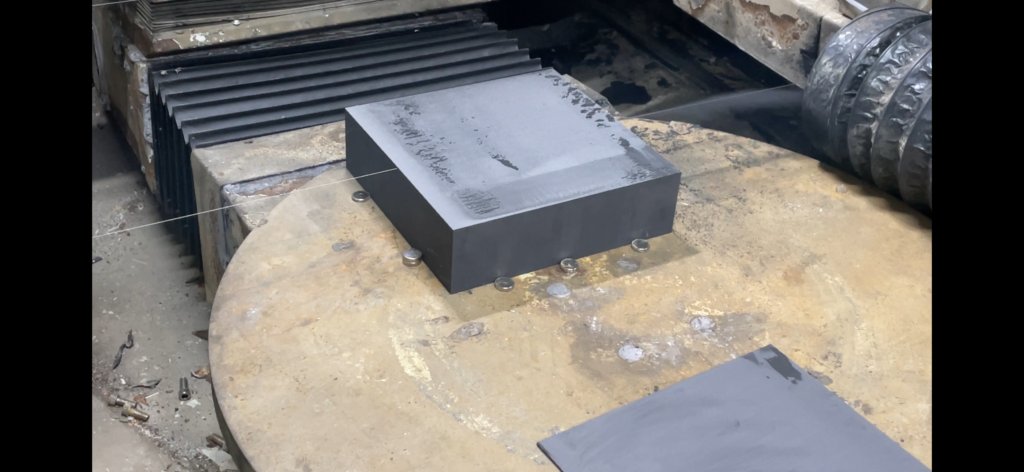
Dimensional Stability Under Production Stress
Chargen-zu-Charge-Konsistenz ist der wahre Killer in der CNC-Elektrodenfertigung.
Warum CNC-Drift
Der Verschleiß von CNC-Werkzeugen folgt einer Kurve. Bei den ersten 100 Teilen ist das Werkzeug scharf und schneidet nach Spezifikation. Dann:
- Der Verschleiß beginnt, den Werkzeugradius zu vergrößern
- Die Spindel übt mehr Kraft aus, um dies auszugleichen
- Die Hitze steigt durch erhöhte Reibung
- Das Werkstück und die Spindel dehnen sich thermisch aus
- Die Maßhaltigkeit beginnt sich zu verschieben
Das Folgende veranschaulicht ein typisches Driftmuster unter gängigen Produktionsbedingungen – die spezifischen Zahlen variieren je nach Maschine und Graphitsorte, aber die Form der Kurve ist in CNC-Elektrodenwerkstätten konstant:
| Produktionslauf | Stückzahl | Gemessene Größe | Status |
|---|---|---|---|
| CNC (illustrativ) | Stück 1–50 | 10,000 ± 0,003 mm | ✓ Gut |
| Stück 51–100 | 10,005 ± 0,008 mm | ~ Akzeptabel | |
| Stück 101–150 | 10,015 ± 0,015 mm | ⚠ Risiko | |
| Stück 151–200 | 10,025 ± 0,020 mm | ✗ Ausschuss |
Bis Stück 150 sind wir außerhalb der Toleranz. Bis Stück 200 fällt die Hälfte der Charge durch die Inspektion.
Die Wahl des Maschinenbedieners: Alle 100 Teile stoppen und die Spindel neu ausrichten (fügt 1–2 Stunden pro 100 Teile hinzu) oder das Risiko von Ausschuss eingehen.
Warum Schneiden stabil bleibt
Beim Diamantdrahtschneiden überträgt sich der Werkzeugverschleiß nicht auf ein Größenwachstum, wie es bei der Bearbeitung der Fall ist.
Ein endloser Diamantdraht verschleißt, indem er stumpf wird, nicht indem er größer wird. Die Schnittbreite bleibt konstant, auch wenn sich die Schnittgeschwindigkeit verlangsamt. Das erste Stück und das 1000. Stück haben die gleiche Schnittbreite: 0,35 mm.
Darüber hinaus verfügen die meisten Präzisionsschneidsysteme über eine automatische Vorschubgeschwindigkeitsregelung. Wenn die Spannung steigt (Schnitt ist langsam), reduziert das System den Vorschub. Wenn die Spannung sinkt (Schnitt ist schnell), erhöht es den Vorschub. Diese Selbstregulierung sorgt für Konsistenz ohne Eingriff des Bedieners.
Diamantdrahtschneiden eliminiert diesen Driftmechanismus vollständig. Die Präzision der Ausrüstung beim Schneiden bleibt bei ±0,03 mm, unabhängig davon, wie viele Teile geschnitten wurden – da der Draht durch Schärfeverlust verschleißt und nicht durch Durchmesseränderung:
| Produktionslauf | Stückzahl | Gemessene Größe | Status |
|---|---|---|---|
| Diamantdrahtschneiden | Stück 1–250 | 10,000 ± 0,030 mm | ✓ Innerhalb der Spezifikation |
| Stück 251–500 | 10,000 ± 0,030 mm | ✓ Innerhalb der Spezifikation | |
| Stück 501–1000 | 10,000 ± 0,030 mm | ✓ Innerhalb der Spezifikation |
Präzisionsangabe basierend auf Ausrüstungsspezifikation: Schnittgenauigkeit ±0,03 mm.
Nach 1000 Teilen bleiben die Schnittbreite und die Maßgenauigkeit auf dem gleichen Niveau wie bei Stück 1. Kein erneutes Einrichten erforderlich.
Für die EDM-Elektrodenproduktion ist dies wichtig, da Sie oft mehrere Elektroden parallel laufen lassen. Wenn eine Charge abweicht, wird die Kavitätengeometrie inkonsistent, und Sie erhalten Variationen von Teil zu Teil im Endprodukt.
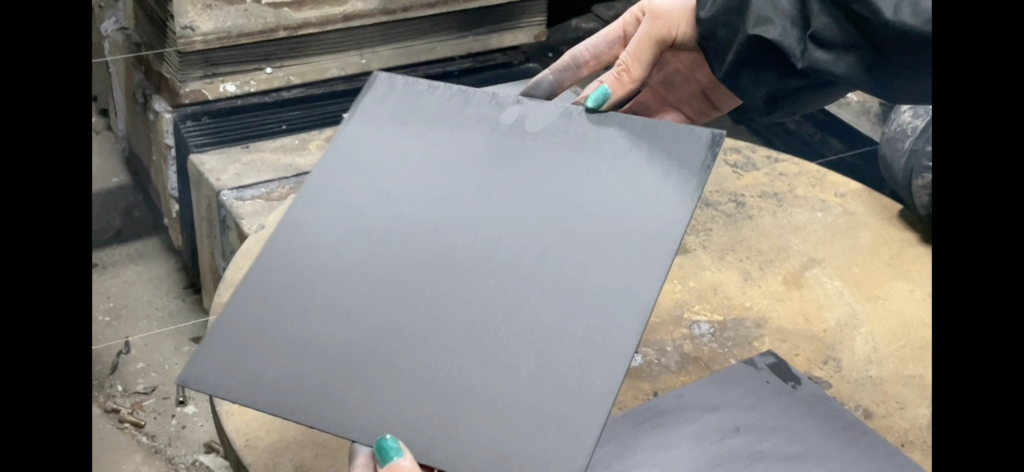
Werkzeugverschleiß und Maßhaltigkeit
Die Wirtschaftlichkeit des Werkzeugverschleißes ist bei den beiden Methoden völlig unterschiedlich.
CNC-Werkzeuglebensdauer vs. Kosten
Ein CNC-Schneidwerkzeug für Graphit (Hartmetall oder diamantbeschichtet) kostet $50–200, abhängig von der Komplexität. Laut SME-Fertigungsrichtlinien, ist das Werkzeuglebensdauer-Management einer der Hauptkostentreiber in der Präzisionsbearbeitung. Für Graphit schneidet es zuverlässig etwa 100–300 Teile, bevor die Maßabweichung einen Werkzeugwechsel erzwingt.
Für 500 Teile benötigen Sie mindestens 2–3 Werkzeugwechsel. Jeder Werkzeugwechsel stoppt die Produktion für 15–45 Minuten (altes Werkzeug entfernen, neues Werkzeug installieren, Spindel neu ausrichten, Testschnitte auf Ausschuss durchführen).
Addieren Sie die Kosten für Ausschussteile, die während der Drift entstanden sind, und die tatsächlichen Werkzeugkosten sind nicht nur das Werkzeug selbst.
Eine Sache, die uns aufgefallen ist: Wir dachten, “höherwertige Werkzeuge halten länger”. Das tun sie nicht, besonders bei Graphit. Ein $150 Diamantbeschichtetes Werkzeug hält ungefähr die gleiche Anzahl von Teilen wie ein $50 Hartmetallwerkzeug. Der Unterschied liegt in der Oberflächengüte, nicht in der Werkzeuglebensdauer.
Lebensdauer und Kosten von Diamantdrahtschneidwerkzeugen
Eine Endlos-Diamantdraht kostet $20–50. Es schneidet zuverlässig 5.000–20.000 Teile, abhängig von der Drahtstärke und Schnittgeschwindigkeit. Werkzeugwechsel erfolgen höchstens einmal pro Schicht, selbst bei hohen Stückzahlen.
When you finally replace the wire, it’s not because of dimensional drift — it’s because the cutting speed has dropped to an uneconomical level (2 mm/min instead of 10 mm/min). But the part quality is still good. You’re replacing the tool for efficiency, not for accuracy.
The second tool change isn’t mandatory for quality; it’s a choice to optimize cycle time.
Cost Profile: CAPEX vs OPEX vs Quality Loss
Die folgende Aufschlüsselung der Kosten ist ein Beispiel für ein typisches Szenario – die tatsächlichen Zahlen variieren je nach Maschinenalter, Stundensatz und Graphitsorte, aber die Kostenstruktur und die Lücke zwischen den beiden Methoden sind repräsentativ für das, was Elektrodenwerkstätten berichten.
CNC Machining Path
| Cost Item | Amount | Notes |
|---|---|---|
| Machine CAPEX (amortized per part) | $40 | Assuming $200k machine, 5-year life, 50k parts/year |
| Tool cost | $150 | 2.5 tools × $60/tool |
| Stopping time for tool changes | $120 | 3 tool changes × 15 min × $500/hour labor |
| Scrap from dimensional drift | $300 | ~30 pieces × $10/piece material + labor |
| Secondary finishing (polishing drift parts) | $200 | Extra rework |
| Total Cost / 500 Parts | $810 | |
| Cost Per Part | $1.62 |
Fair warning: this assumes scrap is caught during QC inspection. If drift escapes to the customer and causes EDM failure, add another $2000+ in customer service costs.
Diamantdrahtschneidweg
| Cost Item | Amount | Notes |
|---|---|---|
| Machine CAPEX (amortized per part) | $25 | Assuming $100k machine, 5-year life, 50k parts/year |
| Tool cost | $30 | 1 endloser Diamantdraht × $30 |
| Stopping time for tool changes | $0 | No re-tram needed; operator can change wire in 5 min once per shift |
| Scrap from dimensional drift | $10 | ~1 piece from handling, not from tool wear |
| Secondary finishing | $40 | Standard polishing, no rework needed |
| Total Cost / 500 Parts | $105 | |
| Cost Per Part | $0.21 |
The cutting path is roughly 87% cheaper per part.
But the bigger difference isn’t per-part cost — it’s risk. With cutting, dimensional consistency is mechanical. With CNC, it’s operator-dependent. This is why material loss in CNC machining costs much more than the machine time itself — scrap and rework multiply the real expense.
When Each Method Still Makes Sense
We’re not saying CNC is obsolete. There are absolutely scenarios where it’s the right choice.
CNC Wins When:
- Tolerance tolerance is loose — If your electrode can be ±0.5 mm, CNC dimensional drift doesn’t matter
- The geometry is complex 3D — CNC can machine arbitrary curved surfaces. Cutting is limited to planar or simple cylindrical cuts
- The volume is very low — If you need 3–5 parts, CNC programming takes a day; cutting tool setup takes just as long. Neither has an advantage
- The size is very large — Large graphite blocks become expensive to cut (wire cost, longer cut times). CNC might be faster and cheaper for 300×300×500 mm blocks. That said, if process stability is critical, even large parts benefit from cutting
Diamantdrahtschneiden gewinnt, wenn:
- Tolerance is tight — ±0,05 mm oder besser. Hier wird die Maßhaltigkeit des Diamantdrahtschneidens entscheidend
- Volume is 100+ parts — Charge groß genug, um die Werkzeugeinrichtung zu amortisieren, aber nicht so groß, dass die Geschwindigkeit des Drahtschneidens zum Engpass wird
- The geometry is planar or simple — Die meisten EDM-Elektroden sind es. Flache Flächen, einfache zylindrische Bohrungen, gerade Kanten – alles gut innerhalb dessen, was eine Diamantdrahtsäge sauber handhabt
- Material cost is high — Graphit kostet $50–200/kg. Die Schnittbreitenersparnis durch Drahtschneiden (0,3 mm gegenüber 3 mm bei CNC) ist wirtschaftlich relevant. Mehr dazu finden Sie in unserer Analyse von Schnittbreitenverlust beim Graphitschneiden
- Surface quality matters — Das geringere Schadensprofil des Drahtschneidens bedeutet weniger Nacharbeit und eine konsistentere Elektrodenleistung. Die Oberflächenqualität bei EDM-Elektroden ist der Bereich, in dem Diamantdrahtschneiden wirklich glänzt
Hybrid Approach (Most Common in Practice)
Eine Sache, die wir gut funktionieren sehen: grob mit CNC, fein mit Diamantdrahtschneiden.
Verwenden Sie CNC, um schnell Masse zu entfernen, und dann eine Diamantdrahtsäge für die endgültigen Präzisionsflächen. Dies gibt Ihnen:
- Fast stock removal from CNC
- Maßhaltigkeit und saubere Oberfläche durch Drahtschneiden
- No need for elaborate rework
This works best when the cutting surfaces are simple and the complex geometry is on surfaces that don’t need cutting-level precision.
The Real Difference: Physics vs Operator Skill
Letztendlich funktioniert Diamantdrahtschneiden, weil es sich am Materialverhalten von Graphit orientiert. Graphit ist spröde, und das Drahtschneiden nutzt dies aus – die kontrollierte Trennung entlang eines kontinuierlichen Drahtweges ist stabiler, als zu versuchen, ein sprödes Material mit einem rotierenden Werkzeug abzusplittern.
CNC works too, but it requires constant operator attention to catch drift before it creates scrap.
Für die Herstellung von EDM-Elektroden, bei denen Maßhaltigkeit und Oberflächenqualität die Lebensdauer der Elektrode und die Entladungsstabilität direkt beeinflussen, eliminiert Diamantdrahtschneiden die Variabilität. Sie erhalten das gleiche Ergebnis bei Stück 1 und Stück 500.
Diese Wahl – Schneiden vs. Bearbeiten – ist nicht abstrakt. Sie prägt Ihre gesamte Elektrodenproduktionsstrategie, von der Werkzeugauswahl über die Chargenplanung bis zur Qualitätskontrolle. Weitere Informationen darüber, wie sich diese Entscheidung auf den gesamten Fertigungsprozess auswirkt, finden Sie in unserem vollständigen Leitfaden zu Schneiden von EDM-Graphitelektroden.
Next step: Bevor Sie sich für eine Produktionsmethode entscheiden, sollten Sie die spezifischen Herausforderungen verstehen, denen Sie bei jedem Ansatz gegenüberstehen. Unsere vollständige Ressource zu Schneiden von EDM-Graphitelektroden walks through the pitfalls on both sides — so you know what you’re signing up for.