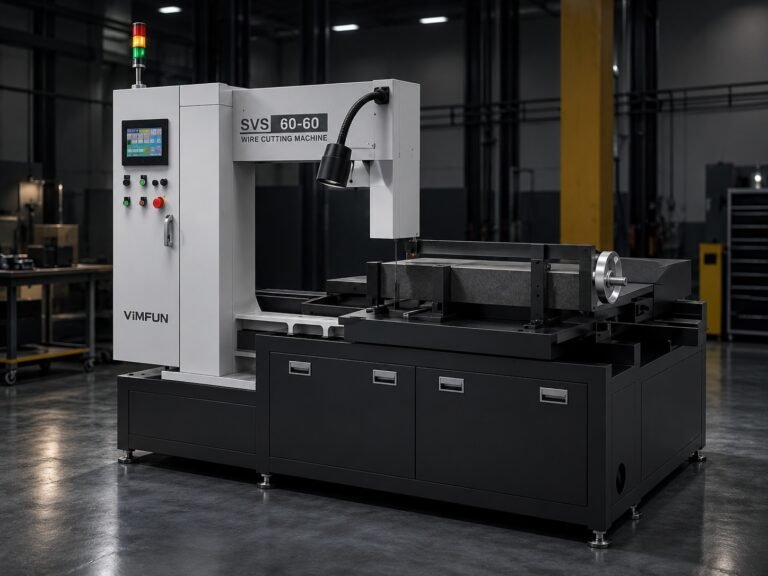
We had a batch of 200 EDM電極 come back from CNC machining. The first 50 looked perfect. By piece 120, they started missing dimensional spec — 10.05 mm instead of 10.00 mm. By 180, half were scrap.
Tool wear. The CNC spindle had drifted, and by the time we caught it, 40% of the batch was useless.
That’s when we started looking at graphite electrode cutting vs machining seriously — specifically, diamond wire cutting as the alternative. Not because wire cutting is some magical new technology, but because it solves a fundamental physics problem that CNC machining can’t escape.
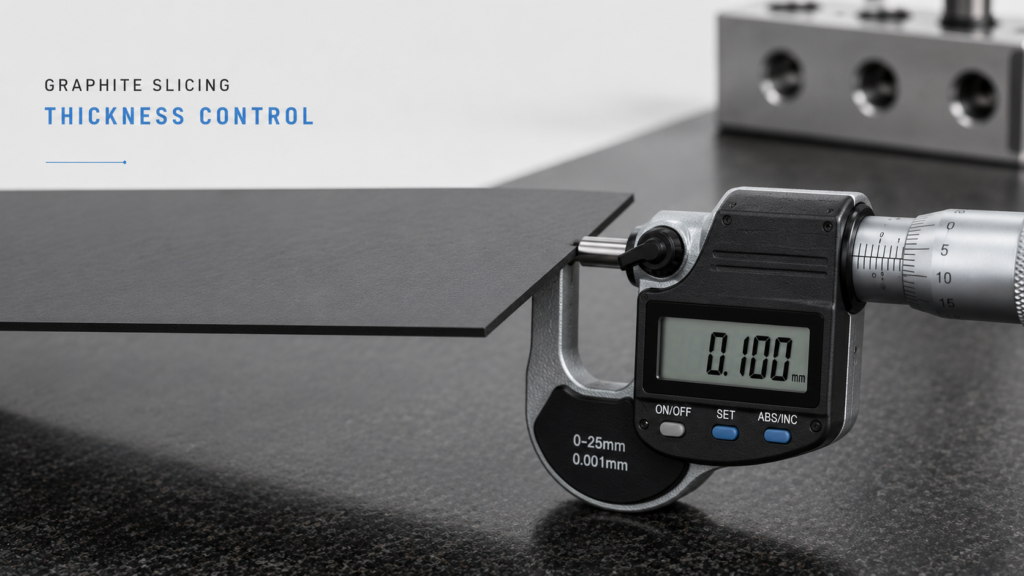
The Fundamental Difference: Separation vs Removal
This is where most people get it wrong. They think cutting and machining are just two ways to do the same job, with one faster or cheaper. They’re not. They solve different problems at the material level.
Machining = Material Removal
A CNC tool presses into the graphite surface with concentrated force. The tool chips away small bits. What happens in the subsurface? The stress concentrates at the tool-material interface, crack initiates below the surface, and that crack propagates into the bulk. The removed chip is damaged — but so is what remains.
This matters for graphite because graphite is brittle. Once a crack starts, it doesn’t stop at the surface. This is one of the core 限界についてお読みになったことがあります。 — the material itself fights back against the tool.
Diamond Wire Cutting = Material Separation
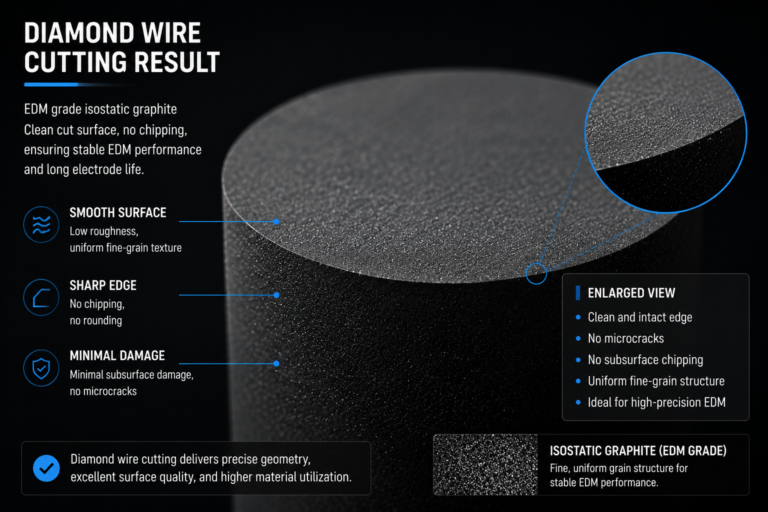
A diamond wire saw moves continuously through the graphite, separating material along a controlled plane. Unlike a rotating CNC tool, the wire distributes cutting force across the entire kerf width (0.3–0.5 mm) rather than concentrating it at a single contact point. Fracture is intentional, immediate, and confined.
The bulk material stays intact. Only the kerf zone experiences separation damage.
For graphite electrodes, this difference cascades through the entire manufacturing process.
Material Damage Profiles: CNC vs Cutting
In our experience, the real cost of CNC machining shows up months later, not during the machining itself.
What CNC Does to Graphite
When the cutting tool engages, you get:
- Primary fracture zone — 0.5–1 mm of surface damage where the tool directly contacts
- Secondary crack propagation — Stress waves push 1–2 mm deeper into the material. These are subsurface cracks, invisible to the eye
- Thermal shock layer — High-speed friction heats the surface, then coolant cools it. Uneven cooling = thermal stress = micro-cracks perpendicular to the cut surface
- Residual stress field — The entire machined zone carries compressive and tensile stress that can take weeks to stabilize
The result: your electrode looks clean when it ships. During EDM operation, those subsurface cracks propagate under discharge heat, and the electrode fails early or wears unevenly.
What Diamond Wire Cutting Does to Graphite
Diamond wire cutting produces:
- Kerf zone — 0.3–0.5 mm of intentional separation. This is where material actually leaves
- Edge micro-fractures — The kerf edge has tiny stress relief cracks (less than 0.1 mm deep). Abrasive polishing removes these completely
- Rapid stress relief — The moment separation is complete, residual stress drops immediately. No heat accumulation, no slow stress stabilization needed
- Bulk integrity — Except for the kerf zone itself, the electrode microstructure is untouched
The edge needs a light polishing pass (standard in any electrode finishing process), but the bulk of the electrode is clean. Unlike CNC, where surface damage from machining runs deep into the material and can’t be fully reversed, cutting’s damage is purely surface-level.
This difference shows up in two places: electrode lifespan and dimensional consistency.
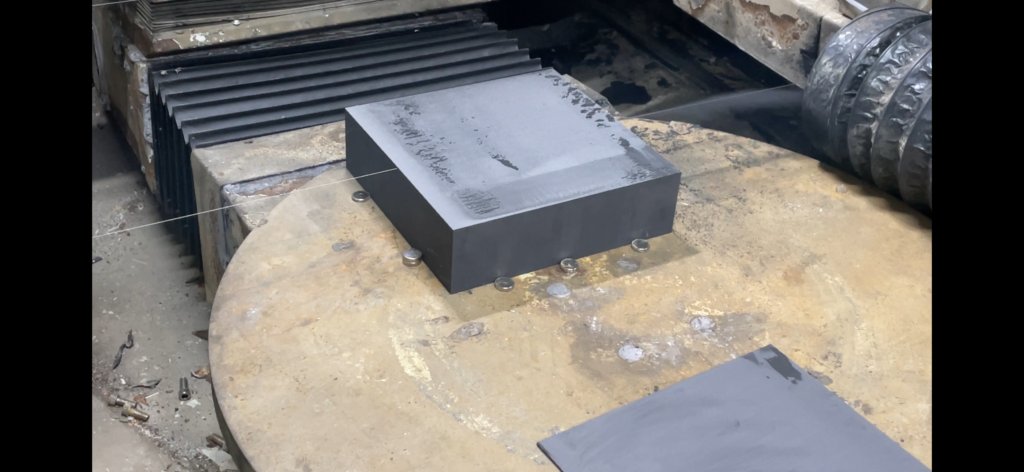
Dimensional Stability Under Production Stress
Batch-to-batch consistency is the real killer in CNC electrode manufacturing.
Why CNC Drifts
CNC tool wear follows a curve. For the first 100 pieces, the tool is sharp and cuts to spec. Then:
- Wear begins increasing the tool radius
- The spindle applies more force to compensate
- Heat rises from increased friction
- The workpiece and spindle thermally expand
- Dimensional accuracy starts moving
The following illustrates a typical drift pattern based on common production conditions — the specific numbers vary by machine and graphite grade, but the shape of the curve is consistent across CNC electrode shops:
| Production Run | Piece Count | Measured Size | Status |
|---|---|---|---|
| CNC (Illustrative) | Piece 1–50 | 10.000 ± 0.003 mm | ✓ Good |
| Piece 51–100 | 10.005 ± 0.008 mm | ~ Acceptable | |
| Piece 101–150 | 10.015 ± 0.015 mm | ⚠ Risk | |
| Piece 151–200 | 10.025 ± 0.020 mm | ✗ Scrap |
By piece 150, we’re outside tolerance. By piece 200, half the batch fails inspection.
The machine operator’s choice: stop every 100 pieces and re-tram the spindle (adds 1–2 hours per 100 pieces), or accept the risk of scrap.
Why Cutting Stays Stable
With diamond wire cutting, the tool wear doesn’t translate to size growth the way it does with machining.
An endless diamond wire wears by becoming dull, not by growing larger. The kerf width remains constant even as the cutting speed slows. The first piece and the 1000th piece have the same kerf width: 0.35 mm.
Moreover, most precision cutting systems have automatic feed rate adjustment. When tension rises (cut is slow), the system reduces feed. When tension drops (cut is fast), it increases feed. This self-regulation keeps consistency without operator intervention.
Diamond wire cutting eliminates this drift mechanism entirely. Equipment cutting precision holds at ±0.03 mm regardless of how many pieces have been cut — because the wire wears by losing sharpness, not by changing diameter:
| Production Run | Piece Count | Measured Size | Status |
|---|---|---|---|
| ダイヤモンドワイヤー切断 | Piece 1–250 | 10.000 ± 0.030 mm | ✓ Within spec |
| Piece 251–500 | 10.000 ± 0.030 mm | ✓ Within spec | |
| Piece 501–1000 | 10.000 ± 0.030 mm | ✓ Within spec |
Precision figure based on equipment specification: cutting accuracy ±0.03 mm.
After 1000 pieces, the kerf width and dimensional accuracy remain at the same level as piece 1. No re-setup required.
For EDM electrode production, this matters because you’re often running multiple electrodes in parallel. If one batch drifts, the cavity geometry becomes inconsistent, and you get part-to-part variation in the final molded product.
Tool Wear & Dimensional Consistency
The economics of tool wear are completely different between the two methods.
CNC Tool Life vs Cost
A CNC cutting tool for graphite (carbide or diamond-coated) costs $50–200 depending on complexity. According to SME manufacturing guidelines, tool life management is one of the primary cost drivers in precision machining. For graphite, it cuts reliably for about 100–300 pieces before dimensional creep forces a tool change.
For 500 pieces, you need at least 2–3 tool changes. Each tool change stops production for 15–45 minutes (remove old tool, install new tool, re-tram spindle, run test cuts on scrap).
Add the cost of scrap pieces produced while drift was happening, and the real tool cost isn’t just the tool itself.
One thing that tripped us up: we thought “higher-grade tools last longer.” They don’t, particularly for graphite. A $150 diamond-coated tool lasts about the same number of pieces as a $50 carbide tool. The difference is surface finish quality, not tool life.
Diamond Wire Cutting Tool Life vs Cost
アン エンドレスダイヤモンドワイヤー costs $20–50. It cuts reliably for 5,000–20,000 pieces depending on wire gauge and cutting speed. Tool changes happen once per shift at most, even on high-volume runs.
When you finally replace the wire, it’s not because of dimensional drift — it’s because the cutting speed has dropped to an uneconomical level (2 mm/min instead of 10 mm/min). But the part quality is still good. You’re replacing the tool for efficiency, not for accuracy.
The second tool change isn’t mandatory for quality; it’s a choice to optimize cycle time.
Cost Profile: CAPEX vs OPEX vs Quality Loss
The following is an illustrative cost breakdown for a typical scenario — actual numbers vary by machine age, labor rate, and graphite grade, but the cost structure and the gap between the two methods are representative of what electrode shops report.
CNC Machining Path
| Cost Item | Amount | Notes |
|---|---|---|
| Machine CAPEX (amortized per part) | $40 | Assuming $200k machine, 5-year life, 50k parts/year |
| Tool cost | $150 | 2.5 tools × $60/tool |
| Stopping time for tool changes | $120 | 3 tool changes × 15 min × $500/hour labor |
| Scrap from dimensional drift | $300 | ~30 pieces × $10/piece material + labor |
| Secondary finishing (polishing drift parts) | $200 | Extra rework |
| Total Cost / 500 Parts | $810 | |
| Cost Per Part | $1.62 |
Fair warning: this assumes scrap is caught during QC inspection. If drift escapes to the customer and causes EDM failure, add another $2000+ in customer service costs.
Diamond Wire Cutting Path
| Cost Item | Amount | Notes |
|---|---|---|
| Machine CAPEX (amortized per part) | $25 | Assuming $100k machine, 5-year life, 50k parts/year |
| Tool cost | $30 | 1 endless diamond wire × $30 |
| Stopping time for tool changes | $0 | No re-tram needed; operator can change wire in 5 min once per shift |
| Scrap from dimensional drift | $10 | ~1 piece from handling, not from tool wear |
| Secondary finishing | $40 | Standard polishing, no rework needed |
| Total Cost / 500 Parts | $105 | |
| Cost Per Part | $0.21 |
The cutting path is roughly 87% cheaper per part.
But the bigger difference isn’t per-part cost — it’s risk. With cutting, dimensional consistency is mechanical. With CNC, it’s operator-dependent. This is why material loss in CNC machining costs much more than the machine time itself — scrap and rework multiply the real expense.
When Each Method Still Makes Sense
We’re not saying CNC is obsolete. There are absolutely scenarios where it’s the right choice.
CNC Wins When:
- Tolerance tolerance is loose — If your electrode can be ±0.5 mm, CNC dimensional drift doesn’t matter
- The geometry is complex 3D — CNC can machine arbitrary curved surfaces. Cutting is limited to planar or simple cylindrical cuts
- The volume is very low — If you need 3–5 parts, CNC programming takes a day; cutting tool setup takes just as long. Neither has an advantage
- The size is very large — Large graphite blocks become expensive to cut (wire cost, longer cut times). CNC might be faster and cheaper for 300×300×500 mm blocks. That said, if process stability is critical, even large parts benefit from cutting
Diamond Wire Cutting Wins When:
- Tolerance is tight — ±0.05 mm or better. This is where diamond wire cutting’s dimensional consistency becomes critical
- Volume is 100+ parts — Batch large enough to amortize tool setup but not so large that wire cutting speed becomes the bottleneck
- The geometry is planar or simple — Most EDM electrodes are. Flat faces, simple cylindrical bores, straight edges — all well within what a diamond wire saw handles cleanly
- Material cost is high — Graphite costs $50–200/kg. The kerf savings from wire cutting (0.3 mm vs 3 mm from CNC) matter economically. For more on this, see our analysis of kerf loss in graphite cutting
- Surface quality matters — Wire cutting’s lower damage profile means less rework and more consistent electrode performance. The surface quality impact on EDM electrodes is where diamond wire cutting really shines
Hybrid Approach (Most Common in Practice)
One thing we’ve seen work well: rough with CNC, finish with diamond wire cutting.
Use CNC to remove bulk material quickly, then use a diamond wire saw for the final precision faces. This gives you:
- Fast stock removal from CNC
- Dimensional consistency and clean surface from wire cutting
- No need for elaborate rework
This works best when the cutting surfaces are simple and the complex geometry is on surfaces that don’t need cutting-level precision.
The Real Difference: Physics vs Operator Skill
At the end of the day, diamond wire cutting works because it aligns with graphite’s material behavior. Graphite is brittle, and wire cutting exploits that — controlled separation along a continuous wire path is more stable than trying to chip away at a brittle material with a rotating tool.
CNC works too, but it requires constant operator attention to catch drift before it creates scrap.
For EDM electrode manufacturing, where dimensional consistency and surface quality directly affect electrode lifespan and discharge stability, diamond wire cutting removes the variability. You get the same result on piece 1 and piece 500.
This choice — cutting vs machining — isn’t abstract. It shapes your entire electrode production strategy, from tool selection to batch planning to quality control. For more context on how this decision cascades through the manufacturing process, see our complete guide to EDM graphite electrode cutting.
Next step: Before committing to a production method, understand the specific challenges you’ll face with each approach. Our complete resource on EDM graphite electrode cutting walks through the pitfalls on both sides — so you know what you’re signing up for.