Precision Graphite Slicing: 5-Stage Process & Proven ROI Guide | Vimfun
Process & ROI Authority

Précision
Graphite Découpe

Precision graphite slicing determines manufacturing quality — not downstream finishing. Explore the complete engineering process, validated cutting parameters, and the full ROI case for diamond wire technology.

±0,05 mmSlicing accuracy
83.2%Material yield
≤ 0.8 mmLargeur du sillon
Ra ≤ 1.25 μmFinition de la surface

Why Graphite Slicing Method Determines Your Material Yield

Découpe de graphite de précision is the controlled process of separating graphite blocks into defined-thickness sections — holding dimensional tolerance, flatness, and parallelism within ±0.05 mm across every slice in a production batch. Unlike conventional cutting, graphite slicing with endless diamond wire technology targets repeatability: the same result on slice 1 and slice 400.

Graphite is one of the most technically demanding materials to cut. Its brittle, porous, and anisotropic structure means conventional methods — band saws, milling cutters, grinding wheels — either contaminate the material through coolant penetration, generate excessive kerf waste, or produce surfaces requiring extensive secondary processing. Endless diamond wire technology solves all three problems simultaneously.

Why the Graphite Slicing Method Matters for Material Yield

The graphite slicing method directly determines material recovery from each block. A band saw's 2.0–4.0 mm kerf yields only 66.4% of material from a 1 m³ block sliced to 4 mm sections. Diamond wire slicing reduces kerf to ≤ 0.8 mm — recovering 83.2% of the same block and producing 42 additional slices per cubic meter. At EDM-grade graphite prices of $15/kg, that is $4,662 in recovered material value per block.

This guide covers the complete graphite slicing process — from material preparation and fixturing to dimensional inspection — along with validated cutting parameters, ROI calculations, and a comparison of competing methods. For deeper dives into specific aspects of slicing accuracy, see the in-depth topic guides in the section below.

Graphite Slicing Accuracy: What ±0.05 mm Means in Production

Graphite slicing accuracy of ±0.05 mm is not just a machine specification — it is the tolerance that downstream operations depend on. Grinding can remove material; it cannot add it back. A slice 0.15 mm undersize has already failed its tolerance before any secondary operation begins. This is why the graphite slicing stage is the single highest-leverage control point in the entire manufacturing chain — errors introduced here propagate irreversibly through every subsequent process. See our EDM electrode manufacturing standards reference for industry tolerance context.
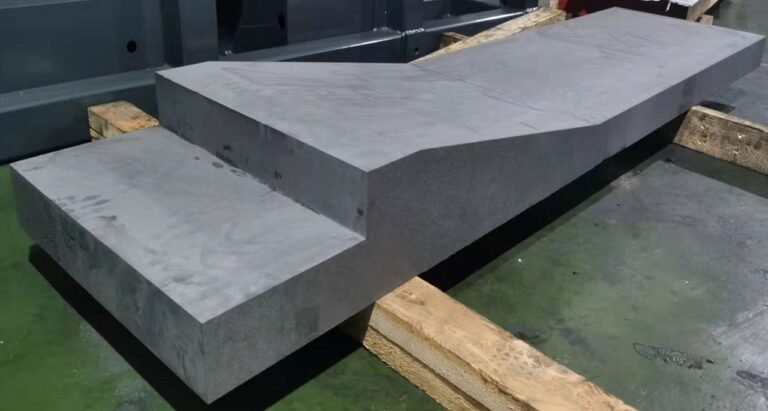
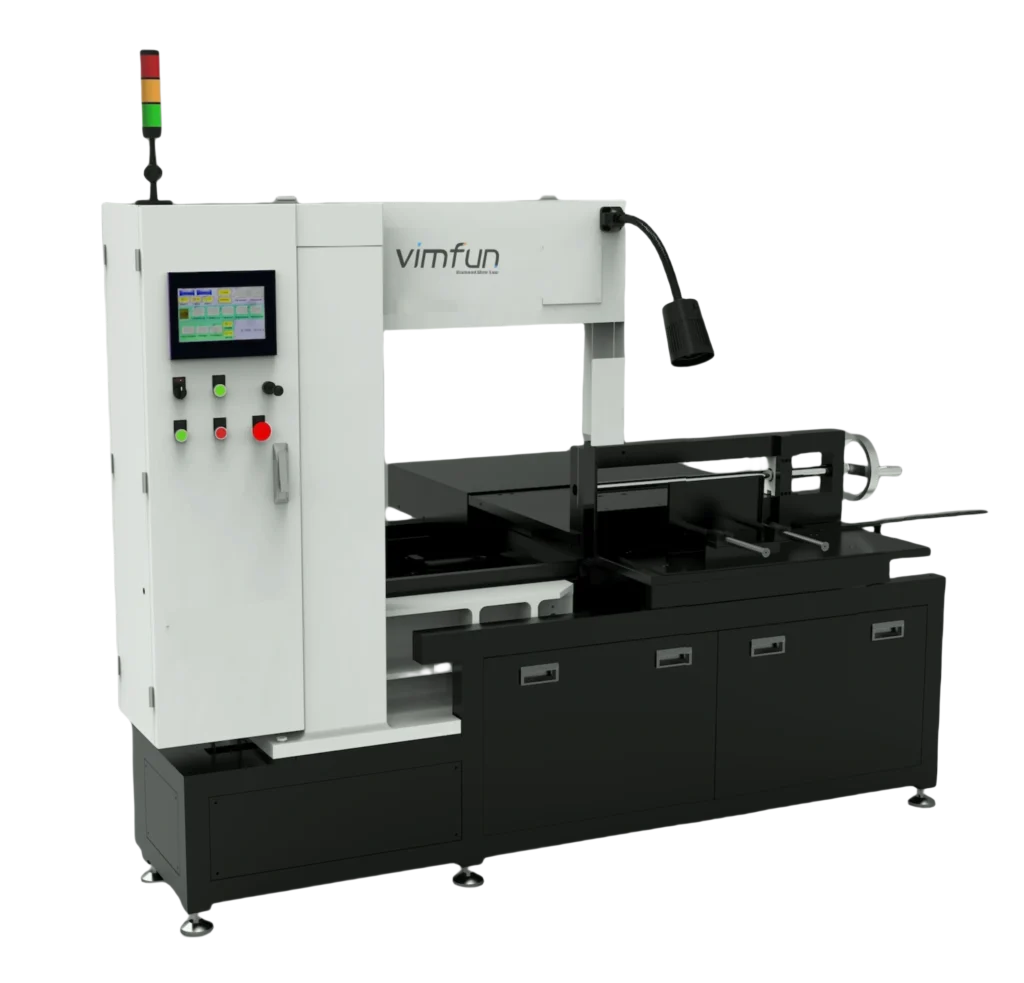
What Is It

What Is Precision Graphite Slicing?

Precision graphite slicing applies a continuous-loop diamond wire under controlled tension and feed rate to produce graphite sections with defined thickness, flatness, and parallelism — all within a tight tolerance window that downstream processes depend on.

Engineering Definition

A continuous closed-loop diamond wire runs at up to 70 m/s in one direction, removing graphite through micro-abrasion rather than mechanical tooth engagement. Wire diameter as fine as 0.3 mm produces a kerf ≤ 0.8 mm — fundamental to the yield advantage over band saws.

Core Mechanism

Why It Differs from Band Saw Cutting

Band saws apply high, intermittent cutting force — causing micro-cracks and edge chipping in brittle graphite. Diamond wire operates via stable micro-grinding at constant tension (150–250 N), resulting in lower subsurface stress, better surface quality, and a 60% narrower kerf.

Key Distinction

Cut Modes: Slice, Profile, and Inner Hole

Endless wire machines support three cut types critical for graphite manufacturing: straight slicing for automated multi-slice batch production; outer profile cutting for complex perimeter geometries; and inner hole cutting — threading wire through a pre-drilled hole to cut full internal contours.

Capability Scope
Material Properties

Why Graphite Is Difficult to Cut Precisely

Isostatic and fine-grain graphite grades present four distinct machining challenges that conventional tools are poorly equipped to handle. Understanding them explains why precision graphite slicing method selection is not interchangeable.

01

Brittleness and Anisotropy

Graphite's layered crystalline structure means its mechanical properties vary by direction. Under high cutting forces, grain boundaries fracture unpredictably, creating edge micro-cracks and subsurface damage that propagate during use. Low-force diamond wire cutting is fundamentally better suited to graphite's fracture mechanics.

02

Porosity and Coolant Contamination

Graphite's open pore structure is valuable in high-temperature applications — but permanently absorbs water-based coolants and cutting oils, altering electrical conductivity and thermal properties. For semiconductor, EDM, and battery graphite, dry cutting is not an option — it is a requirement. Diamond wire slicing requires zero coolant.

03

Conductive Dust Generation

Graphite generates fine, electrically conductive powder during cutting that infiltrates machine components, can short-circuit electrical systems, and creates respiratory hazards. Diamond wire's micro-abrasion cutting action minimizes dust generation compared to abrasive disc or milling methods.

04

Large Block Size and Geometry Complexity

Industrial isostatic graphite is supplied in large blocks — often exceeding 500 × 500 mm and up to 2,500 mm in length. Cutting these at scale with consistent dimensional accuracy, while also supporting outer profile and inner contour cuts, requires a machine platform conventional saws cannot provide.

The Process

The Graphite Slicing Process, Step by Step

Precision slicing is a five-stage sequence in which each step either creates or prevents dimensional error. Understanding this chain is the foundation of process control — and why slicing is the non-rework stage in graphite manufacturing.

01
Matériau
Préparation
Block inspection, surface conditioning, reference face establishment. Incoming material density and grain uniformity set the slicing baseline.
02
Setup &
Fixturing
Workpiece clamping, wire tensioning (150–200 N), axis zeroing. Fixturing rigidity determines vibration level and wire bow throughout the cut.
03
Fil de fer
Coupe
CNC-controlled feed at 50–100 mm/min. Wire speed, tension, and dry cooling all influence kerf width, surface finish Ra, and wire life.
04
Dimensional
Inspection
Thickness, flatness, and parallelism measurement against tolerance spec (±0.05 mm). First-article and statistical process verification.
05
Sortie
& Handoff
Conforming slices transferred downstream. Ra ≤ 1.25 μm finish often eliminates secondary grinding for EDM and battery applications.
Critical principle:  Precision graphite slicing is a non-rework stage. Dimensional errors propagate through every subsequent operation. Grinding can remove material — it cannot add it back. A slice 0.15 mm undersize has already failed its tolerance before any secondary operation begins.
Technical Reference

Validated Graphite Slicing Parameters

The following parameters represent validated reference values from real graphite machining deployments. Final parameters should always be confirmed by trial cutting on the specific grade and block size in use.

ParamètreRangeEngineering Notes
Diamètre du fil0.6 – 1.0 mmHeavier wire for large blocks (≥ 500mm); 0.6 mm for fine-tolerance work and thin slices
Tension du fil150 – 200 NHigher tension = faster cut, shorter wire life. Stable tension = consistent cutting trajectory
Vitesse du fil40 – 70 m/sHigher speed = sharper micro-cut, better surface finish. Maintain through full wire life
Feed Speed50 – 100 mm/minReduce if wire bow or dimensional deviation appears. Tight-tolerance work: use lower half of range
Cooling MethodDry — no coolantLiquid contamination damages porous graphite structure permanently. Dry cutting is non-negotiable
Wire Life~7 days (8h/day)Longer than glass or ceramics. Replace on visible bow or increased cut time. 7-day lead time for new wire
Surface RoughnessRa ≤ 1.25 μmSuitable for direct use in most EDM and battery anode applications without secondary grinding
Slicing Precision±0,05 mmAngular accuracy < 1 arcminute per 100 mm travel. Repeat positioning accuracy ±0.01 mm
Min. Slice Thickness0.1 mmFor ultra-thin battery and semiconductor substrate applications
Wire bow — the critical feed speed constraint: Diamond wire is flexible. Under feed pressure, the wire forms a slight bow (curvature). If feed speed is too high, this bow increases, causing the actual cut path to deviate from the programmed path. When tight tolerances (±0.05 mm) are required, keep feed speed within the lower half of the recommended range. As wire nears end-of-life and bow becomes visible, increase tension slightly and reduce feed speed to extend usable life before replacement.
Material Yield & ROI

The Financial Case for Precise Graphite Slicing

The most direct economic argument for diamond wire adoption is material recovery. For high-value isostatic graphite, the kerf difference between a band saw and a precision graphite slicing wire saw translates directly into additional usable slices — and significant saved material cost per block.

MétriqueScie à rubanScie à fil
Largeur du sillon2.0 mm0,8 mm
Cycle per 4mm slice6.0 mm4.8 mm
Slices per 1 m block166208
Kerf material lost332 mm (33.2%)166 mm (16.6%)
Material yield66.4%83.2%
Extra slices gained+42 slices/block

Basis: 1m³ block, 4mm slice thickness, 1.85 g/cm³ graphite density

+42 Extra slices per 1 m³ block vs. band saw
$4.6K Material saved per block at EDM-grade price ($15/kg)
Each slice = 7.4 kg × 42 slices × $15
83.2% Material yield with diamond wire (vs. 66.4% band saw)
$559K Annual material savings at 10 blocks/month (EDM grade)
precision graphite slicing — diamond wire cutting through large isostatic graphite block
±0,05 mm tolerance
Why It Matters

Why Slicing Accuracy Determines Manufacturing Quality

Every tolerance decision made at the slicing stage compounds through finishing, assembly, and final performance. Slicing is where the manufacturing ceiling is set — or broken.

01

Thickness errors cannot be corrected downstream

Grinding removes material — it cannot add it. A slice 0.15 mm undersize has failed its tolerance before any secondary operation begins.

02

Coolant contamination is permanent and disqualifying

Graphite's open pore structure permanently absorbs cutting fluids, altering conductivity and thermal properties. Any wet cutting method is disqualified for semiconductor, EDM, and battery graphite.

03

Edge quality at slicing determines defect yield

Micro-cracks and edge chipping at the slice edge propagate during downstream handling. Diamond wire's micro-abrasion mechanism minimizes these at source.

04

Surface finish Ra ≤ 1.25 μm eliminates secondary operations

Wire-sawn graphite surfaces are often usable directly in EDM and battery applications, eliminating the secondary grinding step entirely and reducing cycle time.

Applications

Industries That Demand High-Accuracy Graphite Slicing

These industries specify tight slicing tolerances because their downstream processes and end-product performance depend directly on dimensional consistency at the graphite stage. View all cutting machines →

01

EDM Electrode Blanks

Isostatic graphite sliced to ±0.05 mm tolerance for EDM electrode blanks. Thickness consistency determines electrode uniformity. Ra ≤ 1.25 μm finish reduces secondary grinding. EDM-grade graphite: $15/kg; 42 extra slices = $4,662 saved per block.

EDM / Tooling
02

Lithium Battery Anode Sheets

Thin graphite sheets sliced to tight thickness tolerance for lithium-ion anode production. Flatness and parallelism directly affect electrochemical uniformity and battery cycle life. Global graphite market: $12.12B (2025), CAGR 9.6% through 2034.

Energy / EV
03

Semiconductor SiC Components

High-purity isostatic graphite for SiC furnace components: susceptors, heaters, crucibles, insulation rings, wafer carriers. Zero coolant contamination is non-negotiable. Complex geometry requires outer profile and inner-hole cutting capability.

Semi-conducteur
04

Graphite Heaters & Structural Molds

Custom-profile graphite slices for high-temperature heater elements, boat components, and precision molds used in solar and aerospace applications. Complex geometry starts with precise slicing — profile cutting cannot compensate for poor slice quality.

High-Temp / Industrial
In-Depth Topics

Explore Every Dimension of Graphite Slicing

Each topic below isolates a specific engineering aspect of the slicing process — from dimensional control to stress mechanics to manufacturing yield. Together they form a complete process authority framework.

SP — 2.1

Graphite Slicing Process Explained

Detailed breakdown of each slicing stage: material preparation, fixturing, wire cutting parameters, and output handoff. Understand the control points that determine dimensional outcome.

graphite slicing processslicing method
Read in depth →
SP — 2.2

Thickness Control in Graphite Slicing

What thickness consistency actually means in production — the difference between nominal and achieved, where drift originates, and why downstream correction is impossible.

thickness controlgraphite thickness consistency
Read in depth →
SP — 2.3

Flatness and Parallelism in Graphite Slicing

Engineering definitions of flatness and parallelism as applied to sliced graphite. How the slicing stage introduces geometric error and why polishing cannot correct slicing-origin deviations.

graphite slicing flatnessparallelism
Read in depth →
SP — 2.4

Common Defects in Graphite Slicing

Classification of slicing defects: edge chipping, micro-cracking, surface waviness, and subsurface damage. How each forms and why it amplifies through downstream operations.

graphite slicing defectsedge chipping
Read in depth →
SP — 2.5

Kerf Loss in Graphite Slicing

The engineering and economic logic of kerf loss — how kerf width determines per-unit yield, how it scales in high-value graphite grades, and the full ROI calculation for wire saw adoption.

kerf losskerf width graphite
Read in depth →
SP — 2.6

Stress Introduction During Graphite Slicing

Where slicing stress originates, how graphite's anisotropic structure responds to localized force, and why stress-driven warping and cracking are often irreversible regardless of post-slicing treatment.

graphite slicing stressstress in graphite cutting
Read in depth →
SP — 2.7

How Graphite Slicing Affects Manufacturing Yield

The yield logic of the slicing stage: how scrap rate is established before downstream operations begin, and why slicing quality sets a ceiling that no subsequent process can raise.

graphite slicing yieldscrap rate
Read in depth →
Customer Case Study

Mersen Graphite — World's Largest Specialty Graphite Producer

Mersen S.A. (Euronext: MRN), the global leader in specialty graphite serving 30+ industries across 35 countries, deployed the Vimfun SVI 250-80 for large-format isostatic graphite block cutting at their North American facility.

  • Blocks exceeded the capacity of all standard machine models — only the SVI 250-80's 2,500 mm cutting range could handle full block dimensions without pre-cutting
  • Application: high-temperature furnace structural components and semiconductor process equipment blanks
  • Contour cutting capability enables near-net-shape profiling of oversized blocks before final precision machining
  • Dry cutting capability preserved material purity for sensitive semiconductor applications — zero coolant contamination
  • Outer profile and inner-hole cutting on a single machine platform replaced multiple legacy cutting operations
Deployment at a Glance
SVI 250-80
Machine deployed — vertical endless diamond wire saw with 2,500 × 800 mm working range
2,500 mm
Maximum cutting length — largest working range in the Vimfun product line
3-in-1
Slicing + outer profile + inner-hole cutting on one machine
Zero
Coolant contamination — dry cutting required for semiconductor-grade purity
Our Machines

Graphite Slicing Machines by Vimfun

Three machine configurations covering the full range — from precision EDM electrode work to large-scale industrial block processing. All built for dry cutting, CNC feed control, and the dimensional consistency that high-accuracy graphite slicing demands.

SV 60-60 vertical graphite slicing machine for medium-block production

SVI 80-80 — Production Batch + Profiles

  • Max workpiece: 800 × 800 × 800 mm
  • Slice, outer contour, inner-hole cutting
  • Slicing accuracy: ±0.05 mm
  • Most versatile machine in the range
View Machine →
SVI 250-80 large-format graphite slicing machine used by Mersen Graphite

SVI 250-80 — Oversized Blocks & Complex Profiles

  • Max workpiece: 2,500 × 800 mm
  • Deployed by Mersen Graphite
  • Slicing + outer profile + inner-hole
  • Largest working range in the lineup
View Machine →

Ready to Achieve Tighter Slicing Tolerances?

Send a graphite sample — we will run a free test cut and return a full surface quality and kerf measurement report before any purchase commitment. 24-hour response on all technical enquiries.

Free test cut for all graphite grades
24h response on technical enquiries
1 an machine warranty included
Mersen Graphite verified deployment
Défiler vers le haut
Prendre contact
Dites-nous ce dont vous avez besoin - notre équipe technique vous répondra dans les 24 heures.