Chất lượng cắt điện cực graphite quyết định nhiều hơn độ chính xác kích thước — nó đặt ra giới hạn hiệu suất cho mọi quy trình tiếp theo, từ độ ổn định phóng điện EDM đến độ hoàn thiện bề mặt khuôn và năng suất sản xuất. Các khuyết tật phát sinh trong quá trình cắt không chỉ nằm trên điện cực: chúng lan truyền qua chuỗi sản xuất và tích tụ ở mỗi giai đoạn.
Đây là bài viết cuối cùng trong Cắt điện cực đồ chì EDM loạt bài của chúng tôi. Sau khi xem xét vai trò của việc cắt trong sản xuất điện cực, cái những thách thức chính mà người vận hành gặp phải, và tác động kinh tế của việc mất phoi, trang này giải quyết câu hỏi quan trọng cho các quyết định sản xuất: chất lượng cắt ảnh hưởng đến kết quả như thế nào và khi nào việc nâng cấp quy trình cắt có ý nghĩa kinh doanh?
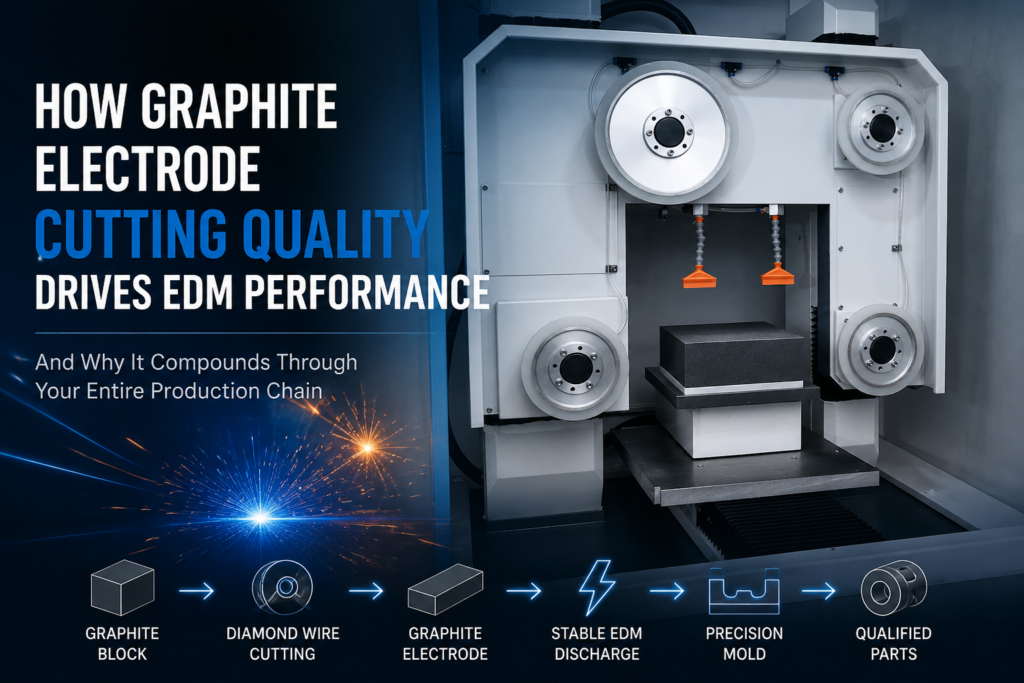
Chất lượng cắt điện cực graphite tạo ra chuỗi sản xuất năm giai đoạn như thế nào
Chất lượng cắt điện cực graphite không hoạt động độc lập. Mọi sai lệch kích thước hoặc khuyết tật bề mặt phát sinh ở giai đoạn cắt đều khởi đầu một chuỗi năm giai đoạn:
Chất lượng cắt → Hình dạng điện cực → Độ ổn định phóng điện → Độ chính xác khuôn → Năng suất chi tiết
Mỗi liên kết trong chuỗi này khuếch đại những gì đã xảy ra trước đó. Sai số hình dạng phát sinh trong quá trình cắt không chỉ đơn thuần là ±0,05 mm — trong EDM, nơi khe hở tia lửa điện thường là 0,01–0,05 mm, sai số đó quyết định tia lửa điện đồng đều hay thất thường. Tia lửa điện thất thường dẫn trực tiếp đến sự biến đổi độ nhám bề mặt trên lòng khuôn, điều này lần lượt ảnh hưởng đến tính nhất quán giữa các chi tiết trong quá trình sản xuất.
| Stage | Đầu vào | Đầu ra |
|---|---|---|
| Cắt | Khối graphite thô | Hình dạng điện cực + trạng thái bề mặt |
| Phóng điện EDM | Chất lượng bề mặt điện cực | Độ ổn định khe hở tia lửa điện |
| Hình thành lòng khuôn | Độ ổn định khe hở tia lửa điện | Độ chính xác kích thước lòng khuôn |
| Sản xuất chi tiết | Độ chính xác lòng khuôn | Dung sai kích thước chi tiết |
| Năng suất sản xuất | Dung sai chi tiết | Tỷ lệ chấp nhận theo lô |
Các nhà sản xuất chỉ đánh giá thiết bị cắt dựa trên chi phí đơn vị trên mỗi điện cực chỉ tính đến hàng đầu tiên của bảng này. Hiệu ứng tích lũy trên cả năm hàng là nơi chi phí thực sự của chất lượng cắt điện cực graphite kém tích tụ — và là nơi lợi tức thực sự từ việc cắt tốt hơn được tạo ra.
Hành vi mài mòn điện cực: Điều kiện cắt quyết định tuổi thọ sử dụng như thế nào
Cách điện cực graphite EDM bị mài mòn trong quá trình phóng điện có liên quan trực tiếp đến trạng thái ứng suất bên trong của nó — trạng thái này được thiết lập ở giai đoạn cắt.
Mài mòn đồng đều so với mài mòn tăng tốc
Một điện cực được cắt tốt — được sản xuất với tốc độ cấp liệu được kiểm soát, các thông số cắt phù hợp và giảm thiểu ứng suất nhiệt — thể hiện sự mài mòn đồng đều: sự ăn mòn nhất quán, có thể dự đoán được trên bề mặt làm việc của nó. Khả năng dự đoán này cho phép người vận hành lên lịch thay thế điện cực trước, duy trì kích thước lòng khuôn nhất quán giữa các lần thay thế và tránh gián đoạn sản xuất giữa chừng.
Một điện cực bị cắt kém — mang các điểm tập trung ứng suất dư, các vết nứt siêu nhỏ dưới bề mặt hoặc các vết sứt cạnh do cắt lực cao — thể hiện sự mài mòn tăng tốc và không đồng đều. Phóng điện tập trung xung quanh các điểm ứng suất và các bất thường bề mặt, gây ra sự loại bỏ vật liệu cục bộ làm biến dạng dần hình dạng điện cực trong quá trình chạy. Người vận hành gặp phải sự trôi kích thước đột ngột không giải thích được thường tìm thấy nguyên nhân gốc rễ ở giai đoạn cắt.
Chỉ loại graphite không quyết định tuổi thọ sử dụng
Các nhà cung cấp graphite chính xác bao gồm SGL Carbon ghi nhận rằng khả năng chống mài mòn của điện cực phụ thuộc vào kích thước hạt, mật độ và chuẩn bị bề mặt — không chỉ riêng thông số kỹ thuật loại vật liệu. Chất lượng cắt là yếu tố trực tiếp trong việc chuẩn bị bề mặt: một quy trình để lại lớp dưới bề mặt bị hư hỏng làm giảm trạng thái ban đầu chức năng của điện cực, bất kể loại graphite được chọn.
Hai điện cực được cắt từ cùng một khối graphite có thể có tuổi thọ sử dụng khác nhau đáng kể chỉ dựa trên cách chúng được cắt. Điện cực nhận được quá trình cắt tốt hơn — giảm thiểu ứng suất, hình dạng cạnh nguyên vẹn, trạng thái bề mặt được kiểm soát — bắt đầu chu trình EDM với nhiều vật liệu của nó ở trạng thái cấu trúc vững chắc, có thể sử dụng được.
Mối quan hệ giữa phương pháp cắt và trạng thái bề mặt điện cực kết quả được phân tích sâu trong hướng dẫn của chúng tôi về chất lượng bề mặt điện cực graphite và hiệu suất EDM.
Độ ổn định phóng điện và chất lượng cắt điện cực graphite
Kiểm soát quy trình EDM phụ thuộc vào tính nhất quán. Mỗi sự kiện phóng điện phải xảy ra trong một khe hở tia lửa điện được kiểm soát, ở một mức năng lượng được kiểm soát, loại bỏ một thể tích vật liệu có thể dự đoán được khỏi phôi. Khi bề mặt điện cực lệch khỏi trạng thái dự định — do các vết sứt cạnh, nứt dưới bề mặt hoặc nhiễm bẩn bề mặt phát sinh trong quá trình cắt — tia lửa điện trở nên thất thường và ngày càng khó kiểm soát.
Ba khuyết tật do cắt gây ra làm suy giảm phóng điện EDM
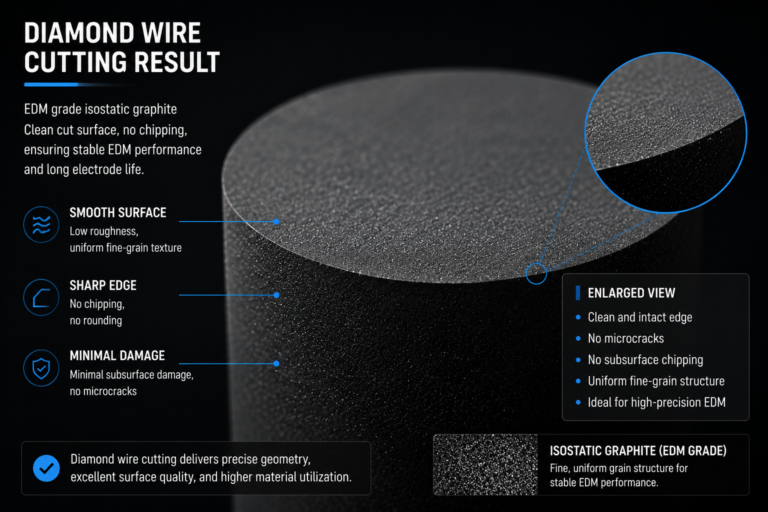
Các bất thường ở cạnh — chipping at corners and fine features creates localized zones of altered electrical resistance. Discharge concentrates at these points rather than distributing evenly across the electrode face, causing uneven cavity erosion and progressive deviation from intended geometry.
Subsurface micro-cracks — formed under high cutting forces or thermally aggressive cutting conditions, these cracks are not always detectable on the surface before the EDM run begins. During EDM, thermal cycling propagates them, causing the electrode to lose geometric accuracy progressively mid-run. The Toyo Tanso EDM electrode guide identifies micro-crack sensitivity as a primary criterion when selecting graphite for high-precision electrode applications, underscoring that cutting-induced cracking is a recognized production risk.
Nhiễm bẩn bề mặt — coolant residue, cutting debris embedded in open graphite pores, or thermal oxidation from aggressive cutting all increase discharge noise. The result is a less predictable spark gap, reduced process stability, and a rougher mold surface than the EDM parameters alone would produce.
Practical Discharge Stability Outcomes
Discharge instability caused by electrode cutting defects produces three consistent production effects:
- Increased mold cavity Ra — additional finishing passes are required to reach surface specification, extending cycle time
- Reduced dimensional repeatability — cavities from the same electrode may vary measurably across the run, requiring more frequent inspection
- Higher machine downtime — arc detection systems pause the EDM machine when discharge becomes erratic, to prevent damage to machine and workpiece
As detailed in our analysis of yêu cầu cắt điện cực graphite, graphite’s brittleness and microstructure make it particularly sensitive to cutting-induced damage — and that sensitivity manifests directly in EDM discharge behavior throughout the production run.
How Graphite Electrode Cutting Quality Affects Mold Surface Finish
The connection between electrode cutting quality and mold surface finish runs through two variables that are both set at the cutting stage: electrode geometry and discharge stability.
The Precision Chain in Toolmaking
For injection molds, die casting tooling, and precision stamping dies, cavity surface finish requirements are stringent. A Ra 0.4 µm cavity specification requires that EDM maintain extremely consistent spark gap geometry through the finishing stage — which in turn requires that the electrode arrive with accurate dimensions, intact edges, and a clean surface free of cutting-induced contamination.
When cutting quality is compromised, the mold reflects it. Surface finish variation that appears to be an EDM parameter problem is frequently traceable to electrode cutting quality. This is why experienced toolmakers evaluate electrode cutting quality as part of mold quality control — not just as an electrode manufacturing metric — because the distinction is irrelevant to the mold’s final dimensional state.
Rework Cost Concentration
The downstream cost of inadequate graphite electrode cutting quality concentrates in mold rework. A cavity that fails dimensional inspection due to electrode-related discharge inconsistency requires additional EDM passes, manual polishing, or — in severe cases — rejection of the mold insert. Each of these outcomes costs multiples of what higher-quality cutting would have cost at the electrode production stage.
This logic is central to our analysis of graphite electrode cutting vs. machining: the relevant comparison is not cost per electrode, but cost per consistently performing electrode — including what happens downstream when consistency is absent.
Decision Framework: When to Invest in Better Graphite Electrode Cutting Quality
Not every EDM application demands the highest tier of electrode cutting precision. The decision to upgrade to a more controlled cutting process should be evaluated across four dimensions.
Dimension 1: Electrode Geometric Complexity
Simple block electrodes used for roughing operations tolerate moderate dimensional variation. Electrodes with fine features, thin walls, sharp corners, or complex multi-surface geometry have no tolerance for chipping or dimensional drift — every edge and every dimension matters. The more complex the electrode geometry, the higher the return on cutting quality investment, because the cutting process is the only stage that can establish — or destroy — that geometry cleanly.
Dimension 2: Batch Production Volume
A single precision electrode may justify premium cutting regardless of batch economics. In batch production of 100, 500, or 1,000 electrodes, the consistency advantages of a precision cutting process — lower rejection rates, fewer mid-run electrode changeovers, predictable electrode performance lot to lot — scale directly with volume. Inconsistency that is tolerable at low volume becomes a significant cost driver at scale.
Dimension 3: Downstream Workpiece Value
EDM operations on high-value tooling — medical device molds, optical tooling, precision forming dies — have a fundamentally different rejection cost than commodity press tooling. When the downstream part or mold insert carries a high rejection cost, the electrode’s contribution to that cost justifies proportionally higher investment in cutting quality at the upstream stage.
Dimension 4: EDM Machine Utilization Rate
High-utilization EDM machines carry significant downtime cost per hour. If electrode-related discharge instability causes frequent machine pauses for arc detection, the cost of that downtime can exceed the cost of better cutting quality within a single production run. Lower-utilization machines on less-demanding work have lower urgency — but the cost calculus shifts quickly as machine utilization rises or as EDM time becomes a production bottleneck.
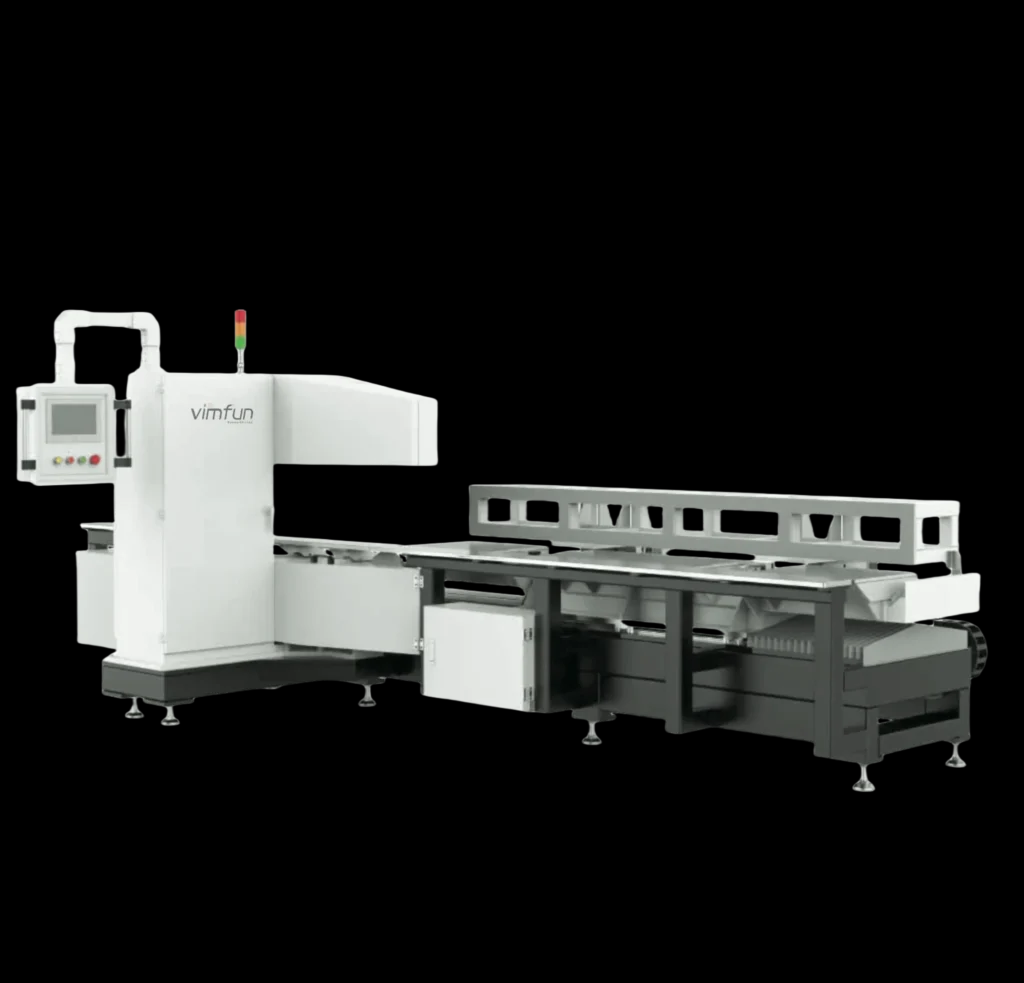
Real-World Scenarios Where Graphite Electrode Cutting Quality Is Critical
Semiconductor Packaging Mold Inserts
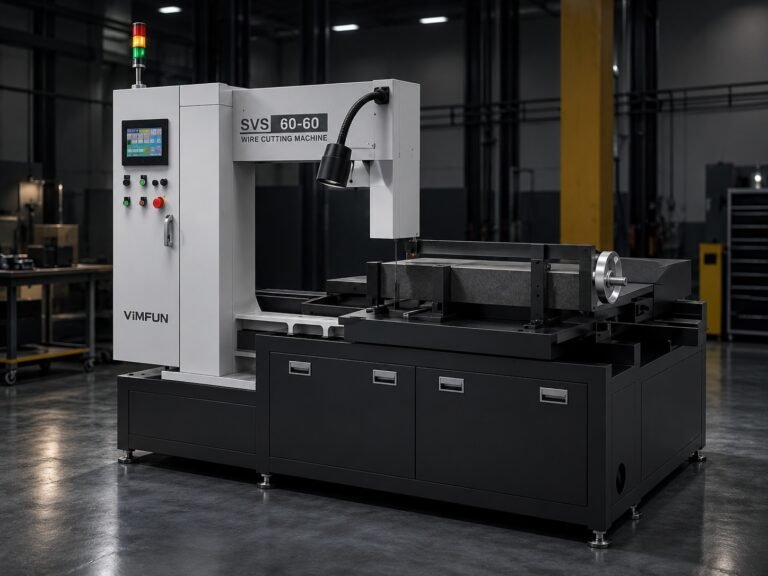
Semiconductor packaging molds require cavity tolerances of ±0.01–0.02 mm. At these tolerances, any dimensional error or surface defect from cutting appears directly in the finished cavity. Wire saw cutting with controlled feed rates, vibration-damped fixturing, and verified post-cut surface inspection is standard practice in this segment — not because it is cheapest per electrode, but because the downstream cost of a failed mold insert is orders of magnitude higher than the investment in precision cutting.
High-Volume Automotive Die Casting Electrodes
Die casting electrodes are often produced in batches of hundreds of units. Here, graphite electrode cutting quality matters for consistency more than for achieving single-electrode precision extremes. An electrode lot with 5% dimensional drift across the batch produces cavity variation that appears as part-to-part scatter in casting — a problem that is difficult to diagnose and expensive to trace back to the electrode cutting source.
Các EDM graphite electrode cutting challenges analysis covers how dimensional drift accumulates in batch production and how cutting process selection is the primary lever for controlling it.
Complex Multi-Feature Precision Electrodes
Electrodes used for fine ribs, micro-textures, precise radii, and multi-level geometry demand that cutting preserve every edge without chipping and maintain geometry without drift. For these electrodes, their value is almost entirely in their geometry: the graphite material cost is secondary to the precision that cutting either preserves or destroys. A cutting process that cannot hold geometry on complex features makes the material investment irrelevant.
Conclusion: Graphite Electrode Cutting Quality Is a Compounding Investment
Graphite electrode cutting quality is not a localized variable that affects only the electrode. It is the first decision in a manufacturing chain that ends at part quality and production yield. The cascade from cutting through discharge stability through mold accuracy through production yield means that investing in cutting quality improvement has a multiplied return — not a one-to-one return.
For manufacturers evaluating whether to upgrade electrode cutting processes, the relevant question is not “how much does better cutting cost?” but “how much does inconsistent cutting cost at every downstream stage?”
To understand the complete EDM graphite electrode cutting system — from the role of cutting in manufacturing through process selection, quality control, and performance optimization — visit our full guide to Cắt điện cực đồ chì EDM.