Graphite electrode cutting quality determines more than dimensional accuracy — it sets the performance ceiling for every downstream process, from EDM discharge stability to mold surface finish and production yield. Defects introduced during cutting do not stay in the electrode: they cascade through the manufacturing chain and compound at each stage.
This is the final article in our EDM graphite electrode cutting series. After examining the role of cutting in electrode manufacturing에서 key challenges operators encounter, and the economic impact of kerf loss, this page addresses the question that matters for manufacturing decisions: how much does cutting quality actually affect outcomes, and when does upgrading a cutting process make business sense?
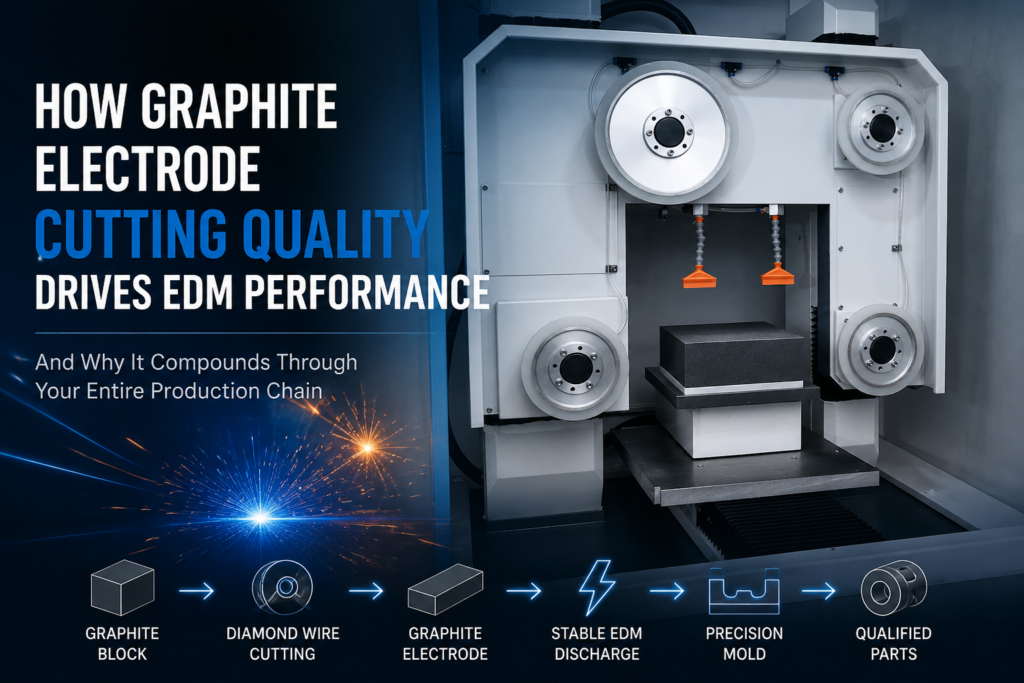
How Graphite Electrode Cutting Quality Creates a Five-Stage Manufacturing Cascade
Graphite electrode cutting quality does not operate in isolation. Every dimensional deviation or surface defect produced at the cutting stage initiates a five-stage cascade:
Cutting Quality → Electrode Geometry → Discharge Stability → Mold Accuracy → Part Yield
Each link in this chain amplifies what preceded it. A geometric error introduced during cutting does not remain at ±0.05 mm in isolation — in EDM, where the spark gap is typically 0.01–0.05 mm, that same error determines whether discharge is uniform or erratic. Erratic discharge translates directly into surface roughness variation on the mold cavity, which in turn affects part-to-part consistency across the production run.
| 단계 | Input | 출력 |
|---|---|---|
| 절단 | Raw graphite block | Electrode geometry + surface state |
| EDM discharge | Electrode surface quality | Spark gap consistency |
| Mold cavity formation | Spark gap consistency | Cavity dimensional accuracy |
| Part production | Cavity accuracy | Part dimensional tolerance |
| Production yield | Part tolerance | Acceptance rate per batch |
Manufacturers who evaluate cutting equipment purely on per-electrode unit cost account only for the first row of this table. The compounding effect across all five rows is where the real cost of poor graphite electrode cutting quality accumulates — and where the real return on better cutting is generated.
Electrode Wear Behavior: How Cutting Conditions Determine Service Life
The way an EDM graphite electrode wears during discharge is directly connected to its internal stress state — which is established at the cutting stage.
Uniform vs. Accelerated Wear
A well-cut electrode — produced with controlled feed rates, appropriate cutting parameters, and minimal thermal stress introduction — exhibits uniform wear: consistent, predictable erosion across its working surface. This predictability allows operators to schedule electrode changes in advance, maintain consistent cavity dimensions between replacements, and avoid mid-run production interruptions.
A poorly cut electrode — one carrying residual stress concentrations, subsurface micro-cracks, or edge chipping from high-force cutting — exhibits accelerated and non-uniform wear. Discharge concentrates around stress points and surface irregularities, causing localized material removal that progressively deforms the electrode profile during the run. Operators who experience unexplained mid-run dimensional drift frequently find the root cause at the cutting stage.
Graphite Grade Alone Does Not Determine Service Life
Precision graphite suppliers including SGL Carbon document that electrode wear resistance depends on grain size, density, and surface preparation — not material grade specification alone. Cutting quality is a direct factor in surface preparation: a process that leaves a damaged subsurface layer reduces the electrode’s functional starting state, regardless of the graphite grade selected.
Two electrodes cut from the same graphite block can exhibit substantially different service lives depending solely on how they were cut. The electrode that received better cutting — lower stress introduction, intact edge geometry, controlled surface state — begins the EDM cycle with more of its material in a structurally sound, usable condition.
The relationship between cutting method and the resulting electrode surface state is analyzed in depth in our guide to graphite electrode surface quality and EDM performance.
Discharge Stability and Graphite Electrode Cutting Quality
EDM process control depends on consistency. Every discharge event should occur within a controlled spark gap, at a controlled energy level, removing a predictable volume of material from the workpiece. When the electrode surface deviates from its intended state — due to edge chipping, subsurface cracking, or surface contamination introduced during cutting — the discharge becomes erratic and increasingly difficult to control.
Three Cutting-Induced Defects That Impair EDM Discharge
Edge irregularities — chipping at corners and fine features creates localized zones of altered electrical resistance. Discharge concentrates at these points rather than distributing evenly across the electrode face, causing uneven cavity erosion and progressive deviation from intended geometry.
Subsurface micro-cracks — formed under high cutting forces or thermally aggressive cutting conditions, these cracks are not always detectable on the surface before the EDM run begins. During EDM, thermal cycling propagates them, causing the electrode to lose geometric accuracy progressively mid-run. The Toyo Tanso EDM electrode guide identifies micro-crack sensitivity as a primary criterion when selecting graphite for high-precision electrode applications, underscoring that cutting-induced cracking is a recognized production risk.
표면 오염 — coolant residue, cutting debris embedded in open graphite pores, or thermal oxidation from aggressive cutting all increase discharge noise. The result is a less predictable spark gap, reduced process stability, and a rougher mold surface than the EDM parameters alone would produce.
Practical Discharge Stability Outcomes
Discharge instability caused by electrode cutting defects produces three consistent production effects:
- Increased mold cavity Ra — additional finishing passes are required to reach surface specification, extending cycle time
- Reduced dimensional repeatability — cavities from the same electrode may vary measurably across the run, requiring more frequent inspection
- Higher machine downtime — arc detection systems pause the EDM machine when discharge becomes erratic, to prevent damage to machine and workpiece
As detailed in our analysis of 흑연 전극 절단 요구 사항, graphite’s brittleness and microstructure make it particularly sensitive to cutting-induced damage — and that sensitivity manifests directly in EDM discharge behavior throughout the production run.
How Graphite Electrode Cutting Quality Affects Mold Surface Finish
The connection between electrode cutting quality and mold surface finish runs through two variables that are both set at the cutting stage: electrode geometry and discharge stability.
The Precision Chain in Toolmaking
For injection molds, die casting tooling, and precision stamping dies, cavity surface finish requirements are stringent. A Ra 0.4 µm cavity specification requires that EDM maintain extremely consistent spark gap geometry through the finishing stage — which in turn requires that the electrode arrive with accurate dimensions, intact edges, and a clean surface free of cutting-induced contamination.
When cutting quality is compromised, the mold reflects it. Surface finish variation that appears to be an EDM parameter problem is frequently traceable to electrode cutting quality. This is why experienced toolmakers evaluate electrode cutting quality as part of mold quality control — not just as an electrode manufacturing metric — because the distinction is irrelevant to the mold’s final dimensional state.
Rework Cost Concentration
The downstream cost of inadequate graphite electrode cutting quality concentrates in mold rework. A cavity that fails dimensional inspection due to electrode-related discharge inconsistency requires additional EDM passes, manual polishing, or — in severe cases — rejection of the mold insert. Each of these outcomes costs multiples of what higher-quality cutting would have cost at the electrode production stage.
This logic is central to our analysis of graphite electrode cutting vs. machining: the relevant comparison is not cost per electrode, but cost per consistently performing electrode — including what happens downstream when consistency is absent.
Decision Framework: When to Invest in Better Graphite Electrode Cutting Quality
Not every EDM application demands the highest tier of electrode cutting precision. The decision to upgrade to a more controlled cutting process should be evaluated across four dimensions.
Dimension 1: Electrode Geometric Complexity
Simple block electrodes used for roughing operations tolerate moderate dimensional variation. Electrodes with fine features, thin walls, sharp corners, or complex multi-surface geometry have no tolerance for chipping or dimensional drift — every edge and every dimension matters. The more complex the electrode geometry, the higher the return on cutting quality investment, because the cutting process is the only stage that can establish — or destroy — that geometry cleanly.
Dimension 2: Batch Production Volume
A single precision electrode may justify premium cutting regardless of batch economics. In batch production of 100, 500, or 1,000 electrodes, the consistency advantages of a precision cutting process — lower rejection rates, fewer mid-run electrode changeovers, predictable electrode performance lot to lot — scale directly with volume. Inconsistency that is tolerable at low volume becomes a significant cost driver at scale.
Dimension 3: Downstream Workpiece Value
EDM operations on high-value tooling — medical device molds, optical tooling, precision forming dies — have a fundamentally different rejection cost than commodity press tooling. When the downstream part or mold insert carries a high rejection cost, the electrode’s contribution to that cost justifies proportionally higher investment in cutting quality at the upstream stage.
Dimension 4: EDM Machine Utilization Rate
High-utilization EDM machines carry significant downtime cost per hour. If electrode-related discharge instability causes frequent machine pauses for arc detection, the cost of that downtime can exceed the cost of better cutting quality within a single production run. Lower-utilization machines on less-demanding work have lower urgency — but the cost calculus shifts quickly as machine utilization rises or as EDM time becomes a production bottleneck.
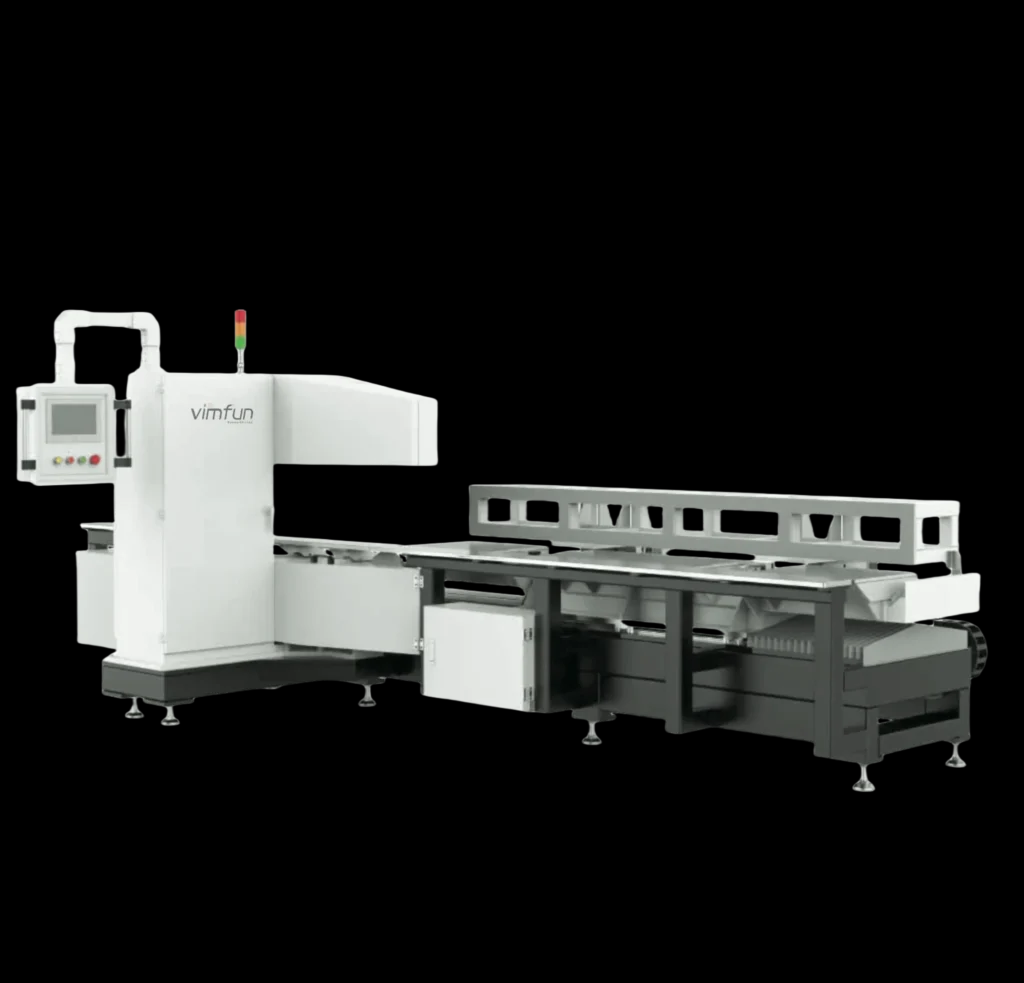
Real-World Scenarios Where Graphite Electrode Cutting Quality Is Critical
Semiconductor Packaging Mold Inserts
Semiconductor packaging molds require cavity tolerances of ±0.01–0.02 mm. At these tolerances, any dimensional error or surface defect from cutting appears directly in the finished cavity. Wire saw cutting with controlled feed rates, vibration-damped fixturing, and verified post-cut surface inspection is standard practice in this segment — not because it is cheapest per electrode, but because the downstream cost of a failed mold insert is orders of magnitude higher than the investment in precision cutting.
High-Volume Automotive Die Casting Electrodes
Die casting electrodes are often produced in batches of hundreds of units. Here, graphite electrode cutting quality matters for consistency more than for achieving single-electrode precision extremes. An electrode lot with 5% dimensional drift across the batch produces cavity variation that appears as part-to-part scatter in casting — a problem that is difficult to diagnose and expensive to trace back to the electrode cutting source.
그만큼 EDM graphite electrode cutting challenges analysis covers how dimensional drift accumulates in batch production and how cutting process selection is the primary lever for controlling it.
Complex Multi-Feature Precision Electrodes
Electrodes used for fine ribs, micro-textures, precise radii, and multi-level geometry demand that cutting preserve every edge without chipping and maintain geometry without drift. For these electrodes, their value is almost entirely in their geometry: the graphite material cost is secondary to the precision that cutting either preserves or destroys. A cutting process that cannot hold geometry on complex features makes the material investment irrelevant.
Conclusion: Graphite Electrode Cutting Quality Is a Compounding Investment
Graphite electrode cutting quality is not a localized variable that affects only the electrode. It is the first decision in a manufacturing chain that ends at part quality and production yield. The cascade from cutting through discharge stability through mold accuracy through production yield means that investing in cutting quality improvement has a multiplied return — not a one-to-one return.
For manufacturers evaluating whether to upgrade electrode cutting processes, the relevant question is not “how much does better cutting cost?” but “how much does inconsistent cutting cost at every downstream stage?”
To understand the complete EDM graphite electrode cutting system — from the role of cutting in manufacturing through process selection, quality control, and performance optimization — visit our full guide to EDM graphite electrode cutting.