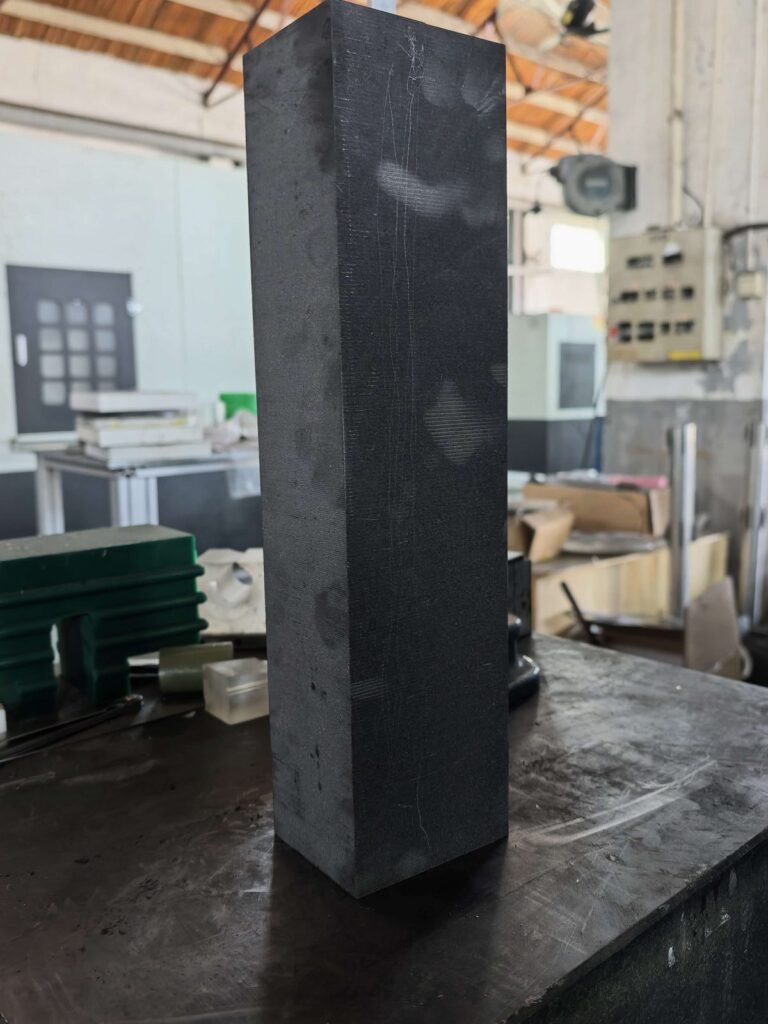
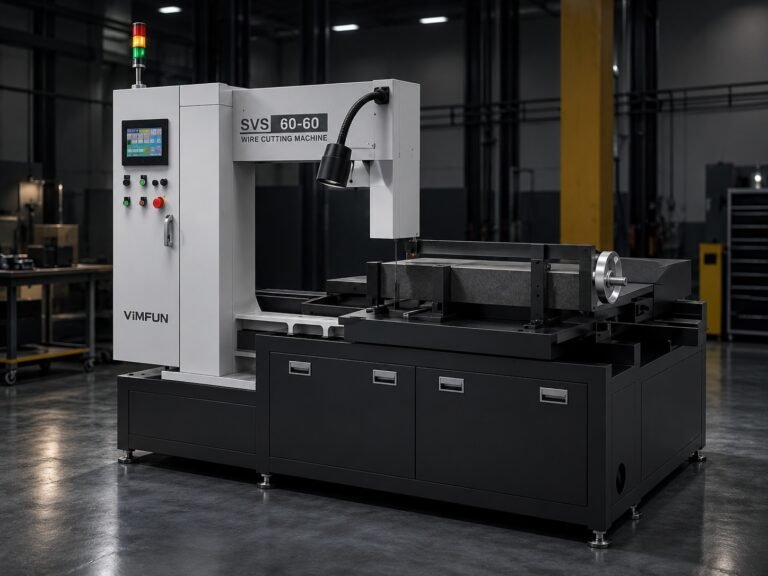
Isostatic graphite block cutting is usually judged on kerf width and speed, but the figures that decide how much stock you leave for finishing are flatness, squareness and size. We cut one 500 × 87 × 70 mm bar out of a larger block on a Vimfun SVI250-80 endless diamond wire saw, measured it with ordinary shop instruments, and are publishing every reading here — including the one that did not go well.
- Flatness of a 500 mm cut face: 0.01–0.03 mm
- Squareness gap against the base face: 0.09–0.15 mm
- Thickness: 69.90–70.10 mm on a 70 mm nominal
- Width: 87.00–87.30 mm on an 87 mm nominal, rising steadily along the length
This isostatic graphite block cutting trial was a first run with wire-diameter compensation switched off, which explains the last line. The details follow.
Why We Ran This Test
An overseas graphite processor asked us for three acceptance figures before ordering a machine: parallelism, squareness and surface flatness, each measured at six points on a test piece. Those are the right questions to ask about isostatic graphite block cutting. A sawn bar that is flat and square can go to finish machining with a thin allowance. One that is bowed or tapered needs a heavy allowance, and the material saved by a narrow kerf is lost again on the mill.
Our article on corte de grafito de alta precisión explains which tolerances are achievable in qualified production. This page is narrower: one bar, one run, raw readings.
Test Setup for Isostatic Graphite Block Cutting
The test piece was grade 2554 isostatic graphite. Starting from a larger block, six cuts produced a rectangular bar with a nominal size of 500 × 87 × 70 mm, so every face of the finished bar is a wire-cut face. For background on the material and the process, see our overview of corte de grafito isostático.
Machine and Cutting Parameters
| Máquina | Vimfun SVI250-80 endless diamond wire saw |
| Diámetro del cable | 0,8 mm |
| Velocidad del cable | 50 m/s |
| Wire tension | 160 N |
| Velocidad de avance | 42 mm/min |
| Cutting time | 45 minutes in total for all six cuts |
| Wire-diameter compensation | Off |
Our standard cortadora vertical de grafito works on the same endless-wire principle.
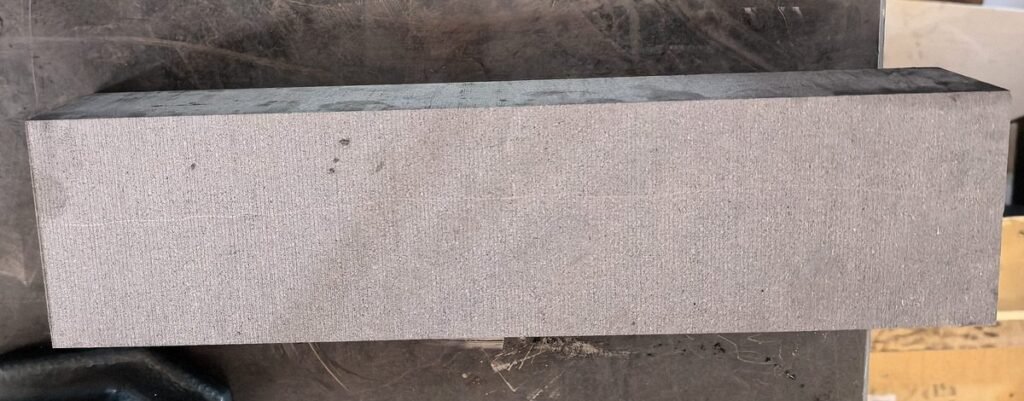
How the Bar Was Measured
After the isostatic graphite block cutting was finished, everything was measured on the shop floor with hand instruments, not on a coordinate measuring machine. Readings were recorded to 0.01 mm.
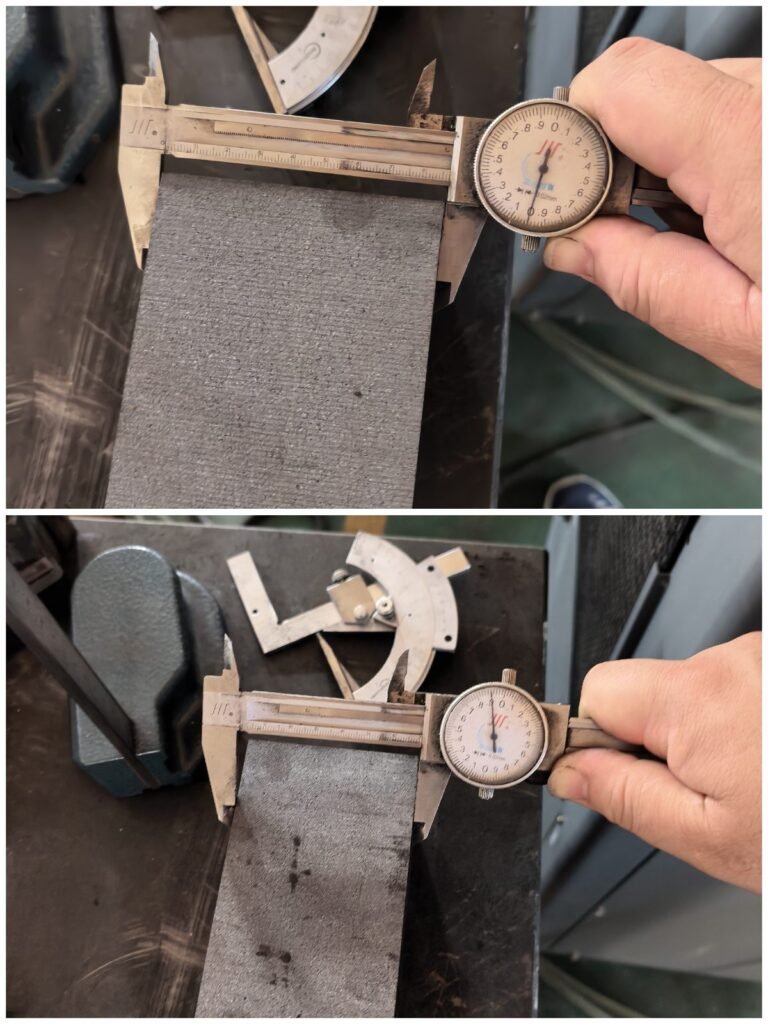
Width and Thickness: Dial Caliper
A dial caliper was applied at six positions spaced along the 500 mm length. Width and thickness were read at each position, in order from one end of the bar to the other.
Squareness: Square and Feeler Gauges
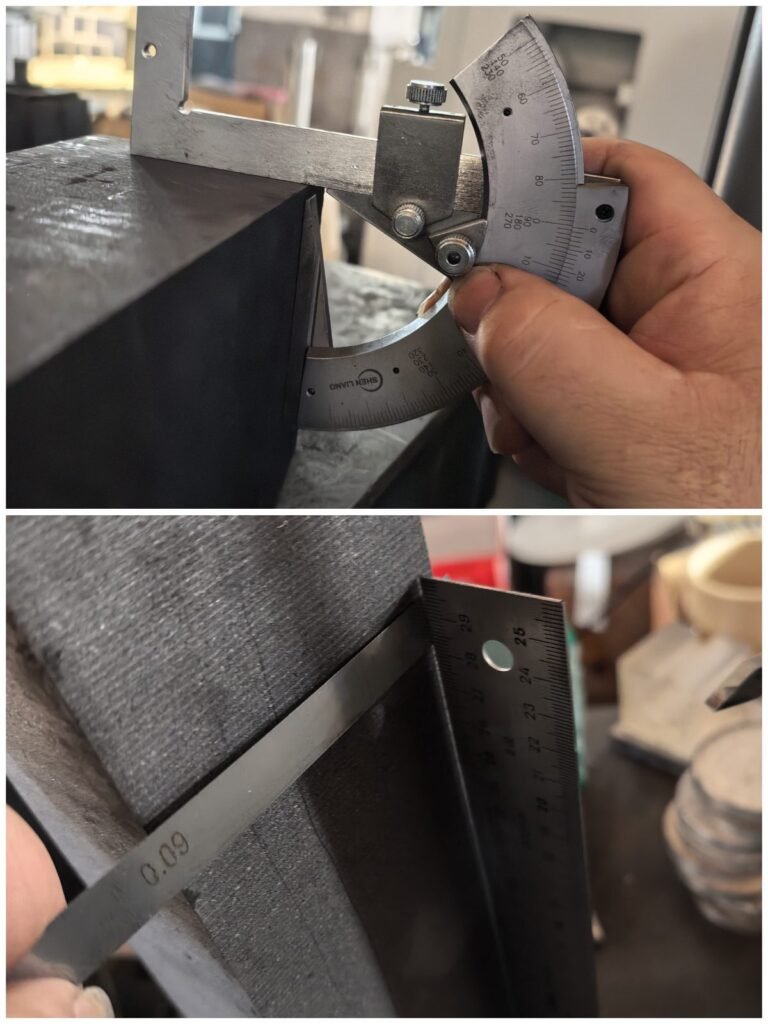
A square was aligned to the base face and brought up to the adjoining face, and feeler gauges of increasing thickness were tried in the gap. The thickest gauge that entered is the recorded value. Six checks were made. A bevel protractor was used alongside as a cross-check and read 90°; its scale is too coarse to resolve deviations this small, so we report the gap, not an angle.
Flatness: Dial Indicator Along the 500 mm Face
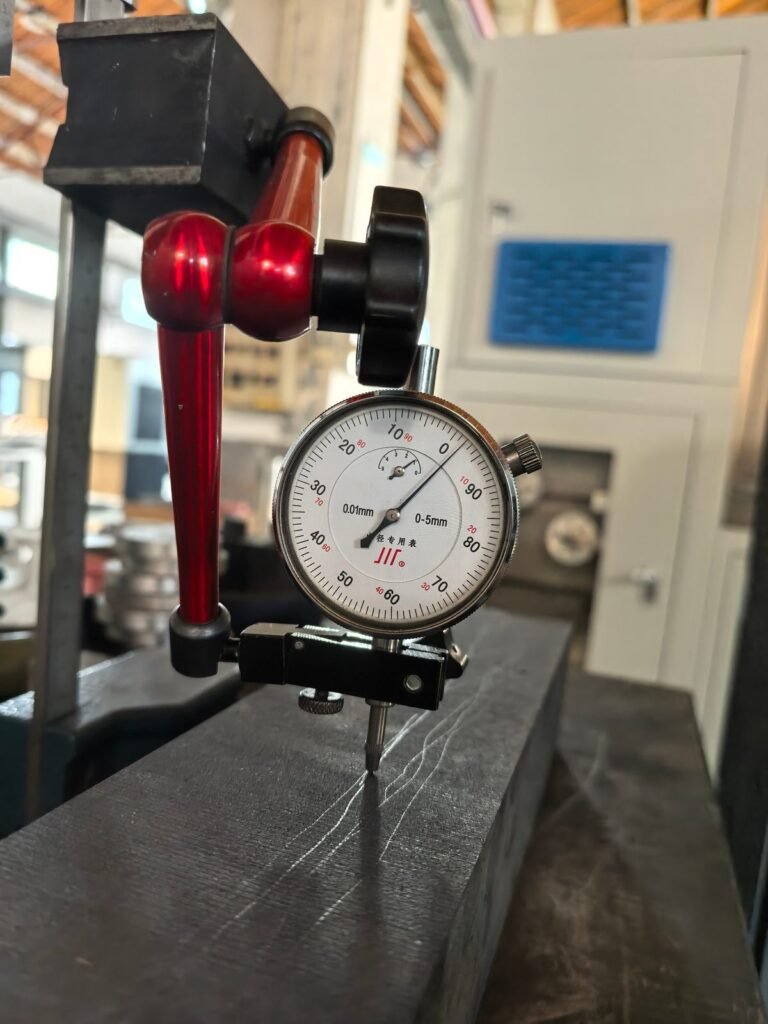
A dial indicator with 0.01 mm graduations on a magnetic stand was read at six positions along one 500 mm cut face. Flatness describes how far a surface departs from a true plane, which matters more than size when the face will be used as a datum.
Results: Every Reading
The table lists every reading taken in this isostatic graphite block cutting test. Nothing has been averaged or left out.
| Measurement | 1 | 2 | 3 | 4 | 5 | 6 | Rango |
|---|---|---|---|---|---|---|---|
| Width, nominal 87 mm | 87.00 | 87.10 | 87.20 | 87.20 | 87.30 | 87.30 | 0.30 |
| Thickness, nominal 70 mm | 69.90 | 69.94 | 70.08 | 70.10 | 70.04 | 69.90 | 0.20 |
| Squareness gap (mm) | 0.09 | 0.10 | 0.15 | 0.15 | 0.12 | 0.09 | 0.06 |
| Flatness reading (mm) | 0.01 | 0.02 | 0.02 | 0.03 | 0.02 | 0.02 | 0.02 |
For width and thickness, positions 1 to 6 run in order along the length. The squareness and flatness readings are six separate checks and do not correspond to the same six stations. Length was recorded as 500 mm.
Reading the Data
Flatness: 0.01–0.03 mm Over 500 mm
This is the strongest result. The largest indicator reading on the 500 mm face was 0.03 mm. For scale, the general flatness tolerance for a 300–1000 mm feature under ISO 2768-2 class H is 0.3 mm. That is the tightest class in a standard which has since been replaced by ISO 22081 but is still quoted on many drawings. A sawn face that holds a tenth of that figure can serve as a datum for the next operation without a skim cut.
Wire bow is the usual cause of a concave cut on a long face. The moderate 42 mm/min feed used for this isostatic graphite block cutting run kept it small. The causes are covered in more depth in our guide to graphite slicing flatness.
Squareness: 0.09–0.15 mm
The six gaps ranged from 0.09 to 0.15 mm, with a mean of 0.12 mm. That is adequate for a sawn blank and is not a finished-part figure. Squareness on a wire saw depends largely on how the block is seated and how the part is re-fixtured between cuts, so it responds to fixturing more than to cutting parameters.
Thickness: 69.90–70.10 mm
Thickness stayed within ±0.10 mm of the 70 mm nominal, rising and falling along the length with no steady trend. That sits inside the ±0.15 mm fine class of ISO 2768-1 for dimensions from 30 to 120 mm.
Why the Width Grew from 87.00 to 87.30 mm
Width is the weak result, and it behaves differently from thickness. It climbs in one direction: 87.00, 87.10, 87.20, 87.20, 87.30 and 87.30 mm from one end of the bar to the other. All six readings are on or above nominal, and the two width faces end up 0.30 mm out of parallel over 500 mm. That is inside the ±0.3 mm medium class of ISO 2768-1 but outside the fine class.
In isostatic graphite block cutting, as in any wire sawing, a steady one-directional error is a systematic one. Diamond wire becomes thinner as it cuts, so the kerf narrows and the part is left slightly oversize. Wire-diameter compensation exists to correct for this. It was not applied in this trial, and our process engineers attribute the taper to that. We have not yet repeated the cut with compensation on, so we are not publishing a corrected figure.
This is also the practical meaning of the ±0.03 mm production tolerance quoted elsewhere on this site. That figure describes isostatic graphite block cutting after the process has been qualified for the grade, with compensation active. It does not describe a first cut.
What the Results Mean for Machining Allowance
For anyone planning isostatic graphite block cutting ahead of milling or grinding, the allowance has to cover the worst deviation on each feature, not the average. On this bar that means 0.03 mm of flatness, a 0.15 mm squareness gap, ±0.10 mm on thickness and a 0.30 mm width taper. The width taper dominates.
A thin, predictable allowance is where a narrow kerf pays off a second time. Our page on low-kerf graphite cutting covers the material-yield side of that calculation.
Limits of This Test
- One bar from one run.
- Hand instruments on the shop floor, not a coordinate measuring machine.
- Flatness was measured on one of the long faces.
- Surface roughness was not measured.
- Wire-diameter compensation was off.
- One graphite grade and one cross-section.
Treat these figures as a record of what happened in one isostatic graphite block cutting trial, not as a machine specification.
PREGUNTAS FRECUENTES
What flatness can a diamond wire saw hold on a 500 mm graphite face?
In this isostatic graphite block cutting test, six indicator readings along one 500 mm face fell between 0.01 and 0.03 mm. The parameters were 0.8 mm wire, 50 m/s wire speed, 160 N tension and 42 mm/min feed.
Why did the width vary more than the thickness?
Width rose steadily along the bar, which points to a systematic cause. The trial ran without wire-diameter compensation, so the narrowing kerf of a wearing wire was not corrected. Thickness showed no such trend.
How long did the cutting take?
All six cuts in this isostatic graphite block cutting trial took 45 minutes in total at a feed rate of 42 mm/min.
Can I send my own graphite grade for a trial cut?
Yes. Tell us the grade, the block size, the target dimensions and the tolerances you need, and we will advise whether isostatic graphite block cutting on a wire saw suits the part.
Request a Cutting Trial
If you are evaluating isostatic graphite block cutting for your own material, send us the grade, the block dimensions and the tolerances you need to hold. Email daria@endlesswiresaw.com or use our contact page.