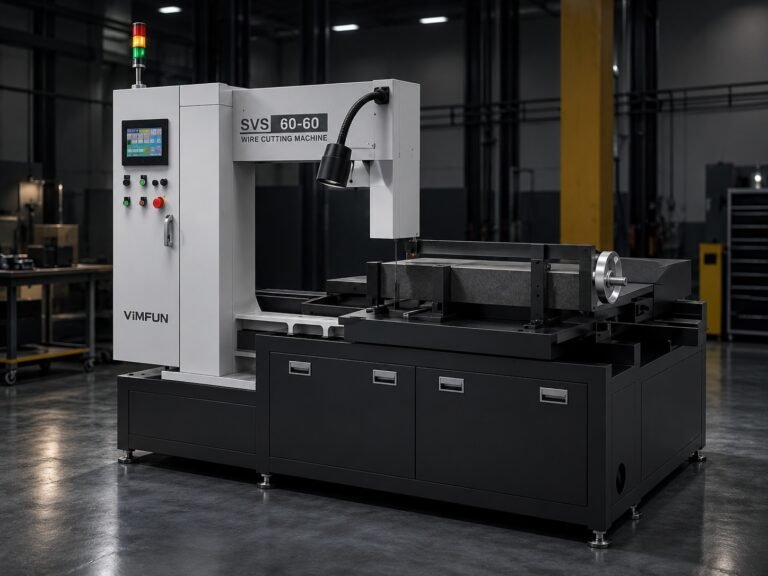
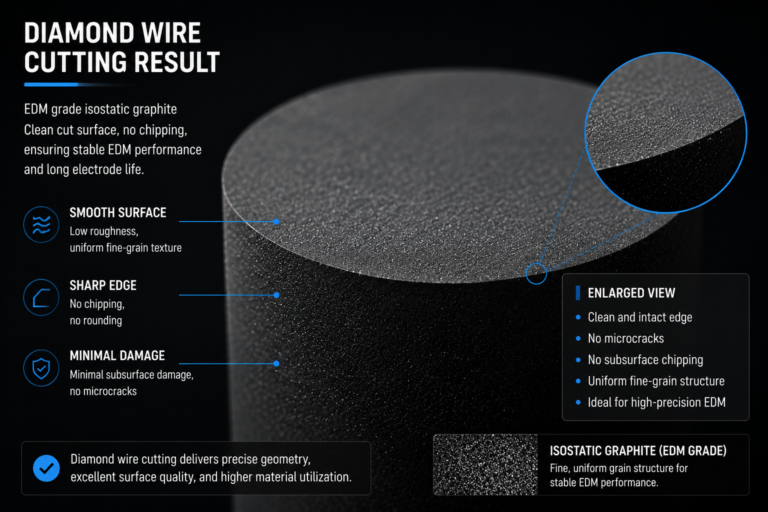
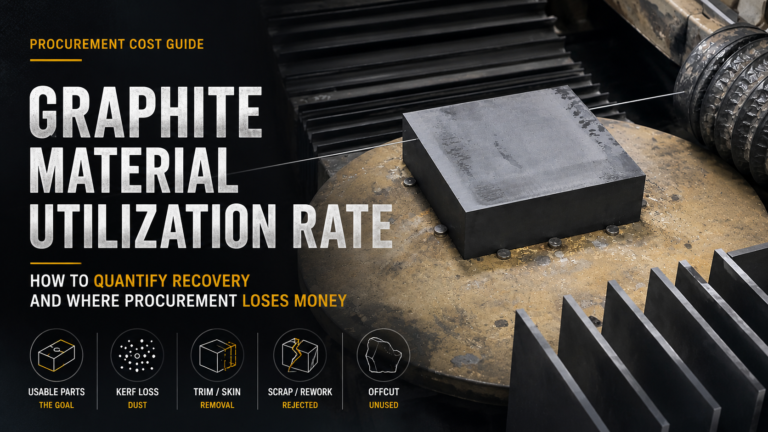
A carbon brush manufacturer recently asked us a blunt question: can diamond wire actually cut copper graphite with 75% copper content, or does the wire load up with smeared copper within the first few cuts? Fair question. Metal-graphite composites sit in an awkward zone for copper graphite cutting — too metallic for standard graphite parameters, too abrasive and friable for conventional metal sawing. This article walks through the actual trial we ran on their material, the numbers we measured, and why the customer ended up ordering an SV series vertical wire saw even though our cutting speed on the high-copper grade was no faster than their existing process.
That last part is worth repeating: on 75% copper graphite, we did not win on speed. We matched it. The purchase decision came down to kerf width, material recovery, operator safety, and automation — and for anyone slicing silver- or copper-loaded brush blanks, those factors dominate the cost equation anyway.
Why Is Copper Graphite So Difficult to Cut Cleanly?
Carbon brushes for low-voltage, high-current applications — forklift traction motors, starter motors, grounding brushes — use copper graphite grades running anywhere from 20% to 80% copper by weight. The copper raises current-carrying capacity; the graphite provides lubrication against the commutator or slip ring. Dimensional and tolerance requirements for these components are governed by standards such as blank” , so the blanks have to come off the saw flat and square enough for downstream precision grinding.
The manufacturing problem is that the two phases fail differently under a cutting edge. Graphite fractures and powders. Copper deforms plastically and smears. Run a toothed blade through a 75% Cu block and you get three familiar symptoms:
- Blade loading. Ductile copper packs into the gullets and onto the cutting edges, so cutting force climbs and surface quality degrades cut by cut.
- Edge tearing. The blade pulls copper particles out of the graphite matrix at the exit edge instead of shearing them, leaving ragged edges that consume grinding stock.
- Wide kerf. Circular blades sized to survive the copper content typically run 2–3 mm kerf. On a material where the copper powder alone can represent the majority of raw material cost, every millimeter of kerf is money converted directly into swarf.
One thing that trips up a lot of first-time evaluators: they benchmark copper graphite cutting methods on speed alone. For electrographite that logic mostly holds. For metal-loaded grades, material recovery per block is usually the bigger lever — we will put numbers on that below.
There is also a process-control angle that gets overlooked. Because blade loading is progressive, a blade process cuts differently on Monday morning than on Friday afternoon. Slice thickness drifts, edge quality drifts, and the grinding department absorbs the variation with extra stock allowance. A process whose cutting edge condition stays stable — or is replaced as a cheap, quick-change consumable — removes that drift from the line.
The Trial Material and Setup
The customer supplied production blocks of two materials from their standard mix:
| Matériau | Copper content | Block format | Requirement |
|---|---|---|---|
| Copper graphite | 75% Cu | Rectangular blocks, ~200 mm length class | Slabs and strips, min. 8 mm slice thickness |
| Natural graphite | 0% | Rectangular blocks, ~210 mm length class | Batch slicing into brush blanks |
Their incumbent process was conventional blade sawing. The acceptance criteria we agreed on before the trial: dimensional consistency adequate for direct feed into precision grinding, no edge tearing on the copper phase, and a realistic wire-life observation — not a three-cut demo.
We ran the trial on a vertical block-slicing machine from our SV family, using an boucle en fil de diamant électrodéposé in the 0.6–1.0 mm diameter class that we use for graphite work. The closed-loop wire runs unidirectionally at high linear speed rather than reciprocating, which matters for metal-loaded materials: each diamond grit passes through the kerf in one direction with consistent chip clearance, and the loop’s full circumference shares the wear instead of concentrating it on a short reversing segment.
Copper Graphite Cutting Results at 75% Cu
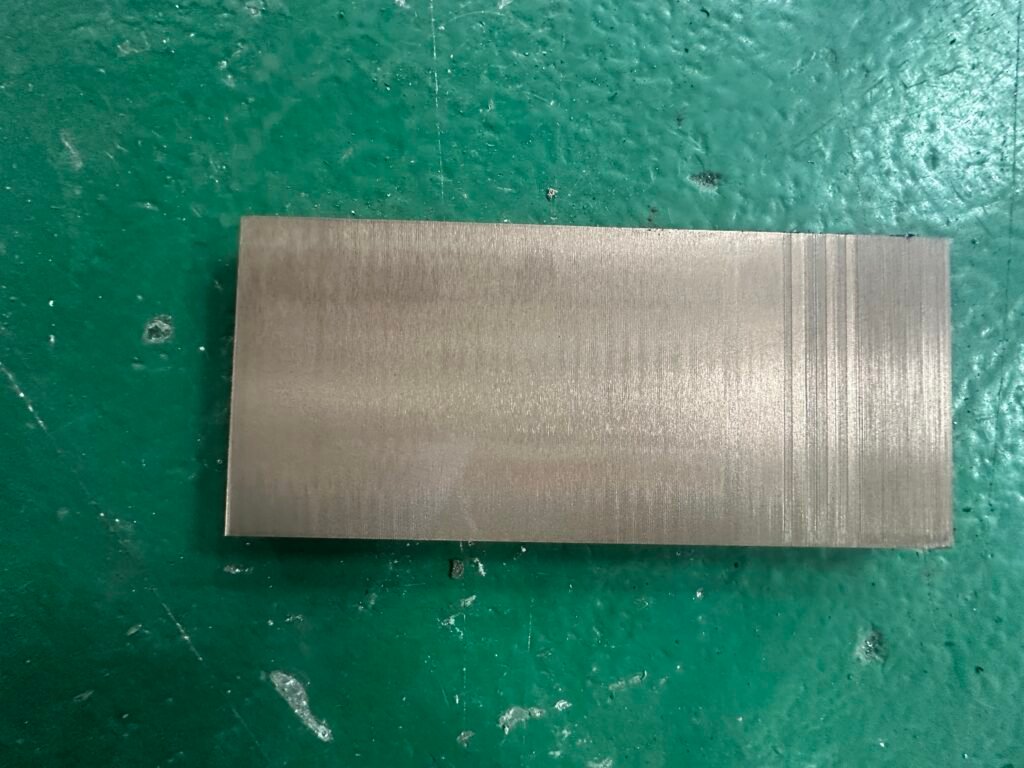
Feed rate on the 75% copper grade settled at 8 mm/min. To be direct about it: that is comparable to what the customer was achieving with their existing blade process. If your only metric is millimeters per minute on high-copper material, a diamond wire saw will not transform your throughput on that specific grade. Anyone who tells you otherwise hasn’t cut much 75% Cu.
What changed was everything around the feed rate:
Kerf width dropped to roughly 1 mm, from the 2.5–3 mm typical of blade sawing. On an 8 mm finished slice, moving from a ~3 mm kerf to a ~1 mm kerf takes the material consumed per slice from ~11 mm down to ~9 mm. Across a block, that is roughly one additional slice recovered for every five cut — a 15–20% improvement in usable yield from the same purchased block. At 75% copper content, the raw block price is driven by copper powder and the mixing/pressing/sintering behind it, so yield improvement flows almost directly to material cost per brush blank. This was the line item that carried the purchase decision.
Edge condition improved. The fine exposed diamond grit shears the copper phase rather than tearing it out, so the slabs came off the saw with clean edges and went to grinding without a deburring step. Less grinding stock allowance also feeds back into the yield math above.
No progressive loading failure. Le bourrage de cuivre sur le fil est le mode de défaillance classique auquel les gens s'attendent dans la coupe de cuivre-graphite, et nous l'avons surveillé spécifiquement. Avec une vitesse de fil adéquate et une avance contrôlée, la boucle unidirectionnelle a continué à dégager la saignée et la force de coupe est restée stable pendant l'essai plutôt que de monter comme le fait une lame chargée. Avertissement : ceci est sensible aux paramètres. Poussez le taux d'avance pour rechercher le débit sur les nuances à haute teneur en cuivre et vous pouvez charger n'importe quel outil abrasif. Le chiffre de 8 mm/min est celui où le processus s'est déroulé de manière stable et répétable, et nous préférerions citer ce nombre plutôt qu'un pic de course héroïque.
Que s'est-il passé sur le graphite naturel ?
La seconde moitié de l'essai a raconté l'histoire inverse. Sur le graphite naturel, le fil diamanté est simplement un processus plus rapide que la scie à ruban — le graphite pur est un matériau idéal pour cela, coupant à sec avec des taux d'avance plusieurs fois supérieurs à ce que permet la nuance de cuivre. Nos paramètres standard de coupe à sec pour le graphite font fonctionner les vitesses de fil de 40–70 m/s avec des taux d'avance de 100 mm/min qui font paraître la scie à ruban lente.
Plus important encore pour un fabricant de balais, le format de la machine verticale permet le tranchage par lots: plusieurs blocs fixés côte à côte et coupés en une seule passe, l'épaisseur de la tranche étant réglée une fois sur le contrôleur et répétée automatiquement. La ligne de graphite naturel du client est passée de la coupe d'un bloc à la fois avec un opérateur à la machine à des cycles de tranchage multi-blocs sans surveillance. Pour une gamme de produits où la même géométrie de flan se répète en volume, les heures machine par millier de flans ont considérablement diminué, même avant de compter les économies de saignée.
Donc, le résumé honnête sur le mélange de matériaux : sur les nuances à haute teneur en cuivre, vitesse égale mais rendement et qualité des bords considérablement meilleurs ; sur les nuances de graphite, mieux sur pratiquement tous les axes. Lequel de ces éléments est le plus important dépend entièrement de votre mélange de production — un atelier qui est à 80 % d'électrographite voit cela différemment d'un atelier spécialisé dans les contacts métal-graphite.
Dust, Safety, and Why Automation Mattered Here
The wire saw configuration changed the risk profile in two ways. First, the cutting zone is enclosed and runs with dust extraction — graphite cuts dry on our machines, so extraction handles the fines at the source instead of letting them settle across the shop. Second, and this is the part the customer’s production manager cared about most: once the block is fixtured and the recipe is loaded, the operator is not near the cut. Slice thickness, feed, and cycle count run from the touchscreen. An exposed spinning blade in a manual sawing operation is a different conversation with your safety auditor than an enclosed wire running in a guarded envelope.
Graphite dust is the operational headache nobody puts in the brochure. It is conductive, it migrates into electrical cabinets, and occupational exposure to graphite dust is regulated in most jurisdictions. Blade sawing throws coarse dust and chips at high energy in an open cutting zone, which is also where the operator’s hands are.
We would not claim the wire saw eliminated their dust management workload — extraction filters still need servicing, and copper-graphite fines are heavier and settle faster than pure graphite dust, which took some adjustment of the extraction setup during commissioning. But moving the operator out of the cutting zone and enclosing the dust source was, in their words, the difference between managing a hazard and engineering it out.
Limitations and Trade-Offs
A few boundary conditions worth stating plainly, because this process is not a universal answer:
High-copper feed rates are what they are. 8 mm/min at 75% Cu is a stable, production-worthy number, but if your business case requires a step-change in throughput on 70–80% copper grades specifically, diamond wire copper graphite cutting alone will not deliver it. The case for the machine rests on yield, quality, and labor — not raw speed on that material.
Coolant strategy differs by material. Graphite grades cut dry with extraction on our machines. Some metal-loaded grades benefit from light lubrication depending on metal content and particle size, and that decision affects downstream cleaning of the blanks. It is a commissioning-stage parameter, not a catalog checkbox — another reason we insist on cutting your actual material first.
Wire is a consumable. Cutting metal-loaded composites wears wire faster than cutting pure graphite. Wire life on graphite runs on the order of a week of single-shift use; on high-copper material, plan for shorter intervals and cost it into your per-blank calculation. We provide the wear data from sample cuts precisely so this number goes into the spreadsheet as a measurement, not a guess.
Very high silver or copper loadings need individual validation. Every metal-graphite grade behaves slightly differently depending on particle size, density, and sintering. We had cut copper graphite before this trial; we still ran the customer’s actual material before quoting, and we would do the same for a silver graphite grade or an 80% Cu grade. Datasheet similarity is not process validation.
Batch slicing gains depend on block standardization. The unattended multi-block runs on natural graphite worked because the customer’s blocks were dimensionally consistent. A shop cutting one-off block sizes captures the kerf and safety benefits but less of the automation benefit.
Next Steps If You Cut Metal-Graphite Composites
If you are evaluating copper graphite cutting for brush blank production, do three things before comparing any equipment quotes. First, calculate your current material recovery: slices actually obtained per block versus the theoretical maximum at zero kerf — on metal-loaded grades this number is usually worse than anyone in the building assumes. Second, get your highest-metal-content grade cut as a sample, not your easiest one; any process looks good on electrographite. Third, ask for measured wire or blade life on your material so consumable cost enters the comparison honestly.
We run free sample cuts on customer-supplied blocks as standard practice — you get back the cut slabs plus measured feed rate, kerf, and wire wear data for your own math.
Send us your block dimensions and material grades, and we will confirm the right machine configuration for your coupe de graphite application. Contact: levy@endlesswiresaw.com.