A block of isostatic graphite is quoted, cut, and delivered as finished parts — and somewhere between the block invoice and the finished part inventory, a meaningful share of the material becomes kerf dust, trim, and offcuts. That gap is the graphite material utilization rate, and it is often invisible to procurement because the cost sits on the operations budget line, not the material line. It looks like a process problem. It behaves like a purchasing problem.
This page is written for the procurement side of the decision, not the operator side. It covers how utilization rate is actually defined, why the same “utilization” number can mean very different things in a quote, and how to weigh utilization pressure across grades of different value. If you are looking for how to reduce kerf on the operator side, see グラファイト切断におけるカーフ損失を削減する方法.
What Graphite Material Utilization Rate Actually Measures
Material utilization rate = (mass or volume of usable parts) ÷ (mass or volume of the input block). Simple in definition, inconsistent in practice.
The number a supplier quotes and the number your finance team sees are frequently different, because there is no universal standard on how to count three edge cases:
- Trim allowance — the outer skin of a graphite block that gets removed to reach dimensional or grain-orientation specification. Some quotes count this as “input consumed,” others count it as pre-cutting waste (excluded from the utilization calculation entirely).
- カーフ損失 — the material turned into dust by each cut. This is usually the largest single loss category in slicing operations and the one that a low-kerf process directly reduces.
- Rework and scrap — parts that fail dimensional or surface inspection. Some suppliers report utilization based on “cut” output; others report based on “shipped” output after QC rejection.
A graphite material utilization rate that excludes trim and counts cut output is not comparable to a number that includes trim and counts shipped output. The second number represents materially more actual recovery for the same headline percentage. If your quotes come from different suppliers with different definitions, the “better” utilization number may be worse in real material terms.
For procurement, the practical rule: ask suppliers to define utilization on the same basis before comparing. Two quotes on the same nominal percentage can differ significantly once the definitions are aligned, and a lower headline number on a stricter definition often beats a higher headline number on a looser one.
Where the Material Actually Goes
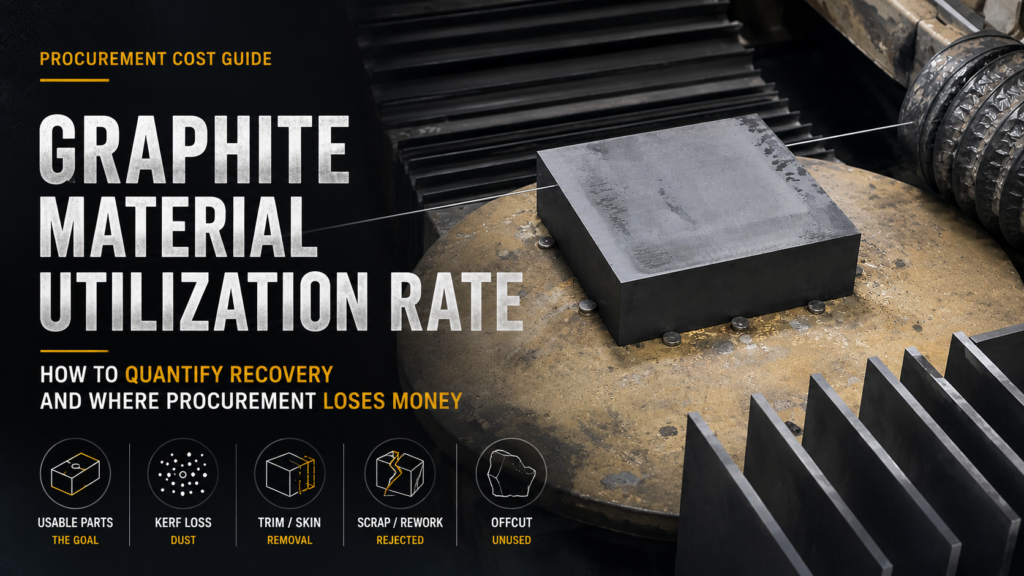
Material loss on a graphite cutting job falls into four categories:
- Kerf — the width of each cut, turned into dust
- Trim / skin removal — the outer layer of the block removed to reach specification
- Rework and scrap — parts rejected at QC
- Handling and offcut — end pieces, jig contact zones, non-productive cuts
The relative share of each depends on grade, geometry, and process control. In slicing operations with high cut counts, kerf usually dominates because a block being sliced into many parts eats kerf many times. A block being sliced into 30 parts eats kerf 29 times; a block being sliced into 100 parts eats kerf 99 times. This is the arithmetic reason graphite material utilization rate is more sensitive to kerf width than to any other single variable when the part count is high, and why the cost impact of kerf reduction compounds on high-volume runs.
Trim and skin removal are grade-dependent, not process-dependent. Grades that require specific grain alignment or tight microstructure control often need more aggressive skin removal to reach specification. This is a fixed cost of using premium grades, not something a better cutting process can recover.
Rework and scrap losses tell you about process control, not material. Blocks with high rework losses usually have kerf loss under control but dimensional consistency out of control — see グラファイト切断収率の向上 for the yield side of the equation.
How Configuration Changes the Math
Graphite material utilization rate is not a property of the graphite. It is a property of the cutting configuration applied to that graphite. The same block cut two different ways produces materially different recovery numbers.
The dominant driver is the ratio of kerf width to part thickness. A 1.0 mm kerf against a 20 mm part is a 5% loss per cut. The same kerf against a 5 mm part is a 20% loss per cut — four times the proportional loss for the same physical kerf. This is why utilization drops sharply on thin-part production: kerf is a fixed cost per cut, and part thickness is the variable it competes against.
For thin-part production, moving to 薄刃グラファイトスライシング is often the largest available utilization gain, provided the grade and geometry support it. The gain is not universal — thin kerf slicing on coarse-grain grades or very deep blocks can produce worse utilization than standard kerf because parameter sensitivity increases rework and scrap.
For complex geometries — mixed contour cutting plus straight slicing — straight utilization rate can mislead. A contour cut that produces a curved offcut consumes more material than a straight slice, but that offcut may be usable input for a smaller downstream part. Some operations track “primary utilization” (usable output from the intended part) separately from “secondary utilization” (usable material recovered from offcuts for other parts). Combined recovery can be meaningfully higher than primary utilization alone suggests, but only if the operation actually has downstream demand for the offcut geometries.
The Cost Math Procurement Needs to See
Utilization rate expressed as a percentage is not directly comparable across grades, because grade cost varies by an order of magnitude between general-purpose and high-end isostatic material. The comparison procurement needs is dollar loss per finished part, not percentage loss per block.
Worked example — hypothetical numbers to show the arithmetic, not empirical benchmarks. Two graphite grades, same target part, same cutting operation:
- Grade A: general-purpose, low unit cost, high utilization
- Grade B: high-end isostatic, high unit cost, moderate utilization
If Grade B costs several times more per kilogram than Grade A, a 5-percentage-point utilization improvement on Grade B saves several times more dollars per part than the same improvement on Grade A. If the operation runs at volume, that difference compounds into a real annual budget number — enough to justify significant process investment in kerf reduction, monitoring, or wire quality on the high-value grade.
This is the reason graphite material utilization rate matters most on the highest-value grades, and why procurement pressure on utilization should be weighted by grade value, not applied uniformly. Chasing marginal utilization gains on the cheapest grade is often a distraction. The same effort applied to the most expensive grade is where the money is.
For a general view of material loss economics across cutting and machining alternatives, see グラファイト加工における材料損失.
What a Realistic Utilization Target Looks Like
There is no single target that applies across grades and geometries, and any specific percentage a supplier quotes should be checked against how they define input, output, and QC rejection.
The correct starting point is not a target percentage — it is a first-principles calculation for the specific job. Given the part thickness, block dimensions, and kerf width the process will actually run at, the maximum theoretical utilization can be computed directly. Real-world utilization will land below that theoretical ceiling because of trim, rework, and handling losses. The gap between theoretical maximum and actual delivered is what process control determines.
If a supplier reports utilization significantly above the theoretical ceiling for the geometry, the definition is wrong somewhere — usually trim being excluded from the input side. If a supplier reports utilization significantly below the theoretical ceiling, the process control issue is likely tension drift, tool wear management, or dimensional monitoring rather than kerf width. Reference process characteristics in 精密グラファイトスライス 構成全体にわたる基本的な期待値について。.
正しい答えは、より優れた切削プロセスではなく、異なるグレードの選択または異なる部品形状である場合があります。原理計算で本質的に低い利用率を示すグレードや形状は、サプライヤーの圧力によって引き上げようとせず、仕様段階で再検討する必要があります。.
調達が利用率で一般的に損失を出す場所
運用上の材料利益を損なう3つの繰り返しパターンはすべて、切削フロアより上流で行われた決定です。.
必要のない部品に最高グレードの材料を指定すること。. 汎用からプレミアム等方圧成形へのグレードアップは、材料費の数倍になることがあります。完成部品が等方圧成形ミクロ構造を必要としない場合、ブロックが購入された時点で、そのコストは回収されない利用率の損失となります。これは切削の問題ではありません。仕様の問題であり、通常は調達ではなくエンジニアリングに起因します。.
切断レイアウトに一致しないブロックサイズを注文すること。. 標準ブロック寸法とターゲット部品寸法は、常にきれいにネストされるとは限りません。意図された切断計画よりも大幅に高くまたは広くブロックを注文すると、切断が始まる前にジョブに無駄が組み込まれます。一部のサプライヤーは、下流の切断計画に一致するカスタムカットブロックを提供しています。サプライヤーの追加コストは、特にプレミアムグレードの場合、回避された材料損失よりも少ないことがよくあります。.
サプライヤーを納入部品コストではなく単価で比較すること。. ブロック価格が低く、利用率が悪いサプライヤーは、完成部品あたりの正味コストが高くなります。入力の単価は追跡するが、出力部品あたりの納入コストは追跡しない調達システムは、間違った数値を最適化します。これは、プレミアムグラファイト運用が、損失が材料ラインではなく運用ラインに現れるため、知らないうちに利益を失う最も一般的な方法の1つです。.
グラファイト切削コストスタック全体でカーフが最も高価な制御可能な変数である理由のピラーレベルのビューについては、以下を参照してください。 低カーフグラファイト切断. 材料レベルで利用率に影響を与えるグレード固有の特性は、以下に文書化されています。 SGL Carbonの特殊グラファイトカタログ そして 東洋タンソの材料データシート, これらは、調達がグレード選択を実際のアプリケーション要件に対して確認するために使用できる参照ポイントです。.
よくあるご質問
グラファイト材料利用率とはどのように計算されますか?
これは、パーセンテージで表される、使用可能な出力と入力の比率です。複雑なのは、「使用可能な出力」と「入力」がサプライヤーによって異なる定義であることです。一部のサプライヤーは、入力側から切断前のトリムを除外します。一部のサプライヤーは、切断出力を報告するのではなく、QCパスされた出荷出力を報告します。見積もりを比較する際は、結論を出す前に、計算を同じ基準(通常はブロック全体の質量に対する出荷出力)に強制してください。.
グラファイト材料利用率が良いとはどういうことですか?
普遍的な目標はありません。正しいベンチマークは、特定の部品の厚さ、ブロックの寸法、およびカーフ幅の理論上の最大値から、トリム、再加工、および取り扱いの現実的な許容値を差し引いたものです。その理論上の上限を参照せずに引用されたパーセンテージは評価が困難です。トリムを除外する高いパーセンテージは、より厳密な定義での低いパーセンテージよりも、実際には悪い場合があります。.
薄い部品で利用率が低いのはなぜですか?
カーフ損失はカットごとの固定コストであり、薄い部品は出力単位あたりにより多くのカットを必要とするためです。高さ100 mmのブロックを厚さ5 mmの部品にスライスするには19回のカットが必要ですが、同じブロックを厚さ20 mmの部品にスライスするには4回のカットが必要です。カーフ幅が1 mmの場合、薄い部品の実行ではブロックの高さの19%がカーフに失われ、厚い部品の実行では4%が失われます。これは算術であり、プロセスの品質ではありません。.
薄いカーフスライスは常に利用率を向上させますか?
いいえ。薄いカーフスライスが機能するグレードと形状では、その利点は本物です。粗粒グレード、深いブロック、またはプロセス監視のない運用では、パラメータ感度が増加して再加工とスクラップが発生するため、薄いカーフスライスは標準カーフよりも利用率が悪くなる可能性があります。特定のグレードと形状での初回記事検証は、生産実行をコミットする前に利点を確認するための正しい方法です。.
調達はすべてのサプライヤーに高い利用率を要求すべきですか?
グレードの価値で重み付けされた場合ははい、均一にではありません。プレミアムグレードでの利用率の向上は、低コストグレードでの同じ向上よりも大幅に多くのドルインパクトをもたらします。最も価値の高いグレードに利用率の圧力を集中させることが、材料予算を動かす場所です。低コストグレードでは、単価競争と納期信頼性が、利用率のわずかなパーセンテージよりも通常重要です。.