A block of isostatic graphite is quoted, cut, and delivered as finished parts — and somewhere between the block invoice and the finished part inventory, a meaningful share of the material becomes kerf dust, trim, and offcuts. That gap is the graphite material utilization rate, and it is often invisible to procurement because the cost sits on the operations budget line, not the material line. It looks like a process problem. It behaves like a purchasing problem.
This page is written for the procurement side of the decision, not the operator side. It covers how utilization rate is actually defined, why the same “utilization” number can mean very different things in a quote, and how to weigh utilization pressure across grades of different value. If you are looking for how to reduce kerf on the operator side, see как уменьшить потери на пропил при резке графита.
What Graphite Material Utilization Rate Actually Measures
Material utilization rate = (mass or volume of usable parts) ÷ (mass or volume of the input block). Simple in definition, inconsistent in practice.
The number a supplier quotes and the number your finance team sees are frequently different, because there is no universal standard on how to count three edge cases:
- Trim allowance — the outer skin of a graphite block that gets removed to reach dimensional or grain-orientation specification. Some quotes count this as “input consumed,” others count it as pre-cutting waste (excluded from the utilization calculation entirely).
- Kerf loss — the material turned into dust by each cut. This is usually the largest single loss category in slicing operations and the one that a low-kerf process directly reduces.
- Rework and scrap — parts that fail dimensional or surface inspection. Some suppliers report utilization based on “cut” output; others report based on “shipped” output after QC rejection.
A graphite material utilization rate that excludes trim and counts cut output is not comparable to a number that includes trim and counts shipped output. The second number represents materially more actual recovery for the same headline percentage. If your quotes come from different suppliers with different definitions, the “better” utilization number may be worse in real material terms.
For procurement, the practical rule: ask suppliers to define utilization on the same basis before comparing. Two quotes on the same nominal percentage can differ significantly once the definitions are aligned, and a lower headline number on a stricter definition often beats a higher headline number on a looser one.
Where the Material Actually Goes
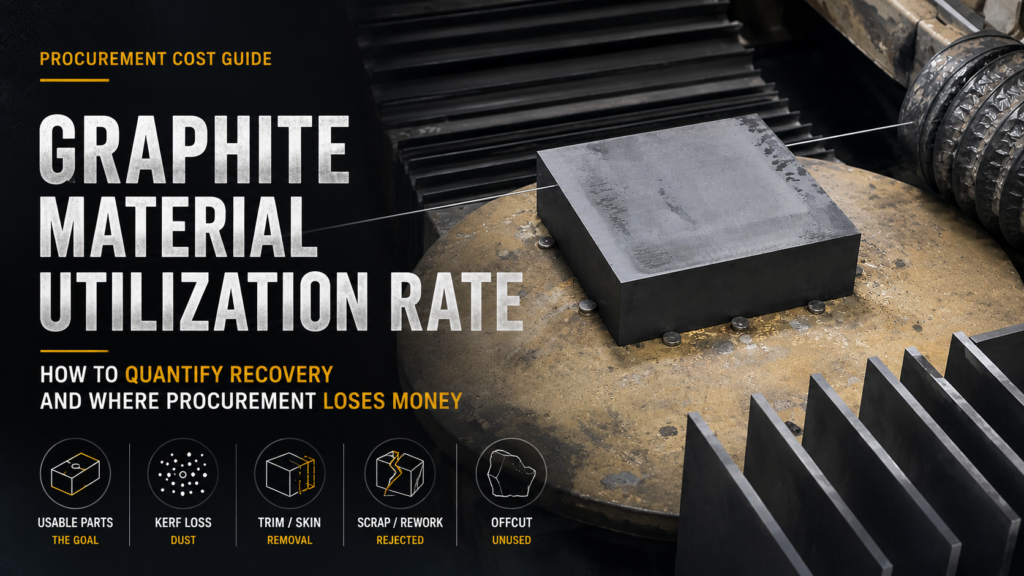
Material loss on a graphite cutting job falls into four categories:
- Kerf — the width of each cut, turned into dust
- Trim / skin removal — the outer layer of the block removed to reach specification
- Rework and scrap — parts rejected at QC
- Handling and offcut — end pieces, jig contact zones, non-productive cuts
The relative share of each depends on grade, geometry, and process control. In slicing operations with high cut counts, kerf usually dominates because a block being sliced into many parts eats kerf many times. A block being sliced into 30 parts eats kerf 29 times; a block being sliced into 100 parts eats kerf 99 times. This is the arithmetic reason graphite material utilization rate is more sensitive to kerf width than to any other single variable when the part count is high, and why the cost impact of kerf reduction compounds on high-volume runs.
Trim and skin removal are grade-dependent, not process-dependent. Grades that require specific grain alignment or tight microstructure control often need more aggressive skin removal to reach specification. This is a fixed cost of using premium grades, not something a better cutting process can recover.
Rework and scrap losses tell you about process control, not material. Blocks with high rework losses usually have kerf loss under control but dimensional consistency out of control — see graphite cutting yield improvement for the yield side of the equation.
How Configuration Changes the Math
Graphite material utilization rate is not a property of the graphite. It is a property of the cutting configuration applied to that graphite. The same block cut two different ways produces materially different recovery numbers.
The dominant driver is the ratio of kerf width to part thickness. A 1.0 mm kerf against a 20 mm part is a 5% loss per cut. The same kerf against a 5 mm part is a 20% loss per cut — four times the proportional loss for the same physical kerf. This is why utilization drops sharply on thin-part production: kerf is a fixed cost per cut, and part thickness is the variable it competes against.
For thin-part production, moving to тонкая резка графита с узким пропилом is often the largest available utilization gain, provided the grade and geometry support it. The gain is not universal — thin kerf slicing on coarse-grain grades or very deep blocks can produce worse utilization than standard kerf because parameter sensitivity increases rework and scrap.
For complex geometries — mixed contour cutting plus straight slicing — straight utilization rate can mislead. A contour cut that produces a curved offcut consumes more material than a straight slice, but that offcut may be usable input for a smaller downstream part. Some operations track “primary utilization” (usable output from the intended part) separately from “secondary utilization” (usable material recovered from offcuts for other parts). Combined recovery can be meaningfully higher than primary utilization alone suggests, but only if the operation actually has downstream demand for the offcut geometries.
The Cost Math Procurement Needs to See
Utilization rate expressed as a percentage is not directly comparable across grades, because grade cost varies by an order of magnitude between general-purpose and high-end isostatic material. The comparison procurement needs is dollar loss per finished part, not percentage loss per block.
Worked example — hypothetical numbers to show the arithmetic, not empirical benchmarks. Two graphite grades, same target part, same cutting operation:
- Grade A: general-purpose, low unit cost, high utilization
- Grade B: high-end isostatic, high unit cost, moderate utilization
If Grade B costs several times more per kilogram than Grade A, a 5-percentage-point utilization improvement on Grade B saves several times more dollars per part than the same improvement on Grade A. If the operation runs at volume, that difference compounds into a real annual budget number — enough to justify significant process investment in kerf reduction, monitoring, or wire quality on the high-value grade.
This is the reason graphite material utilization rate matters most on the highest-value grades, and why procurement pressure on utilization should be weighted by grade value, not applied uniformly. Chasing marginal utilization gains on the cheapest grade is often a distraction. The same effort applied to the most expensive grade is where the money is.
For a general view of material loss economics across cutting and machining alternatives, see Потеря материала при обработке графита.
What a Realistic Utilization Target Looks Like
There is no single target that applies across grades and geometries, and any specific percentage a supplier quotes should be checked against how they define input, output, and QC rejection.
The correct starting point is not a target percentage — it is a first-principles calculation for the specific job. Given the part thickness, block dimensions, and kerf width the process will actually run at, the maximum theoretical utilization can be computed directly. Real-world utilization will land below that theoretical ceiling because of trim, rework, and handling losses. The gap between theoretical maximum and actual delivered is what process control determines.
Если поставщик сообщает об использовании материала, значительно превышающем теоретический предел для геометрии, где-то ошибочно определено — обычно обрезка исключается со стороны входных данных. Если поставщик сообщает об использовании материала, значительно ниже теоретического предела, проблема управления технологическим процессом, вероятно, связана с дрейфом натяжения, управлением износом инструмента или контролем размеров, а не с шириной реза. См. характеристики процесса в прецизионная нарезка графита для базовых ожиданий по различным конфигурациям.
Иногда правильным решением является выбор другого сорта или другой геометрии детали, а не лучший процесс резки. Сорта и геометрии, которые изначально имеют низкий коэффициент использования при расчете по первым принципам, не следует искусственно повышать под давлением поставщика — их следует пересмотреть на этапе спецификации.
Где закупки часто теряют деньги на использовании материала
Три повторяющиеся закономерности приводят к потерям маржи материалов в операциях, и все они связаны с решениями, принятыми до начала резки.
Указание материала самого высокого сорта для деталей, которые в нем не нуждаются. Увеличение сорта с общепромышленного до премиального изостатического может в несколько раз превысить стоимость материала. Если готовая деталь не требует изостатической микроструктуры, эта стоимость является невозвратной потерей использования материала в момент покупки блока. Это не проблема резки. Это проблема спецификации, и она обычно возникает в инжиниринге, а не в закупках.
Заказ размеров блоков, не соответствующих раскладам резки. Стандартные размеры блоков и целевые размеры деталей не всегда идеально сочетаются. Заказ блока, который значительно выше или шире предполагаемого плана резки, создает отходы в задаче еще до начала резки. Некоторые поставщики предлагают блоки, вырезанные на заказ, соответствующие последующим планам резки; дополнительная стоимость поставщика часто меньше, чем избегаемые потери материала, особенно для премиальных сортов.
Сравнение поставщиков по удельной цене, а не по стоимости поставленной детали. Поставщик с более низкой ценой блока и худшим использованием материала поставляет более высокую чистую стоимость за готовую деталь. Системы закупок, которые отслеживают удельную цену входных данных, но не стоимость поставки за выходную деталь, оптимизируют не тот показатель. Это один из самых распространенных способов, которым операции с премиальным графитом теряют маржу, не осознавая этого, поскольку потери отражаются в строке операций, а не в строке материалов.
Для общего обзора того, почему ширина реза является самой дорогой контролируемой переменной в общем стеке затрат на резку графита, см. резки графита с малым пропилом. Характеристики, специфичные для сорта, влияющие на использование материала на уровне материала, документированы в каталоге специальных графитов SGL Carbon и листах данных материалов Toyo Tanso, которые являются точками отсчета, которые закупки могут использовать для проверки выбора сорта в соответствии с фактическими требованиями применения.
ЧАСТО ЗАДАВАЕМЫЕ ВОПРОСЫ
Как рассчитывается коэффициент использования графитового материала?
Это отношение полезного выхода к входу, выраженное в процентах. Сложность заключается в том, что “полезный выход” и “вход” определяются по-разному у разных поставщиков. Некоторые исключают обрезку перед резкой со стороны входа; некоторые сообщают о выходе после резки, а не о выходе после контроля качества. При сравнении предложений приведите расчеты к единой основе — обычно выход после отгрузки к полной массе входного блока — прежде чем делать выводы.
Каков хороший коэффициент использования графитового материала?
Универсального целевого показателя не существует. Правильным ориентиром является теоретический максимум для конкретной толщины детали, размеров блока и ширины реза, минус реалистичный запас на обрезку, доработку и обработку. Любой указанный процент без ссылки на этот теоретический предел трудно оценить. Высокий процент, исключающий обрезку, может быть хуже в реальном выражении, чем более низкий процент при более строгом определении.
Почему коэффициент использования ниже для тонких деталей?
Поскольку потери на ширину реза являются фиксированной стоимостью на рез, а тонкие детали требуют больше резов на единицу выхода. Разрезание блока высотой 100 мм на детали по 5 мм требует 19 резов; разрезание того же блока на детали по 20 мм требует 4 реза. При ширине реза 1 мм это означает потерю 19% высоты блока на резку тонких деталей по сравнению с 4% на резку толстых деталей — до любых других потерь. Это арифметика, а не качество процесса.
Всегда ли тонкая резка улучшает использование материала?
Нет. Для сортов и геометрий, где тонкая резка работает, выигрыш реален. Для крупнозернистых сортов, глубоких блоков или операций без контроля процесса тонкая резка может привести к худшему использованию материала, чем стандартная резка, поскольку чувствительность параметров увеличивает количество доработок и брака. Валидация первого образца для конкретного сорта и геометрии — это правильный способ подтвердить выигрыш перед началом производственной партии.
Следует ли закупкам добиваться более высокого использования материала от всех поставщиков?
Взвешенно по стоимости сорта, да; равномерно, нет. Улучшение использования материала для премиального сорта дает значительно большее влияние в долларах, чем такое же улучшение для недорогого сорта. Концентрация усилий по повышению использования на сортах с самой высокой стоимостью — это то, где перемещается бюджет на материалы. Для недорогих сортов конкуренция по удельной цене и надежность доставки обычно важнее, чем маржинальный процент использования.